Month: December 2016

A tale of two Queens

Two Queens

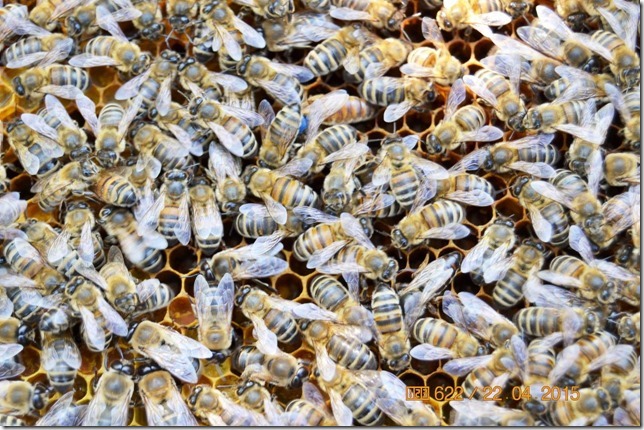
On the seventh of September 2014 I was called to a swarm of Bees in a very large Cedar Tree, the swarm was half way along a very thin branch and the owner did not want the tree cut in any way and it was not possible to shake the swarm down because of the proximity of a dividing wall, the bees would have landed half on the wall and the rest in the next garden. A thee stage scaffolding tower was built and a bait hive placed on the top, two weeks later the swarm was still there and did not look like moving, a week later a phone call announced the bees where in the box. In the evening I went to see what had happened, yes the bees were in the box. Now an Eighty year old man trying to get a brood box full of bees down a scaffolding tower was not a pretty sight but in the end we both arrived on terra firma at the same time and all intact.

The bees were hived in a national brood box and left to settle in, four days later on the 6th of November I inspected the bees and found three Queen cells on the first frame and a very dark Queen, I put the box together, the bees tore down two cells and one hatched, I thought that there was no way the hatched Queen would survive let alone mate. The swarm survived the winter and on first inspection I found the dark Queen on the second frame with brood so I put the hive together thinking how well they had done to survive the winter.

Two weeks later I asked Sue Bird if she would like to use the colony for her Beginner’s Class and on the Saturday afternoon Sue rang me to ask if I knew that the colony had two Queens a very dark one and a yellow one, she had marked the yellow Queen. I thought better get there quickly as they will not both be there for long, just how wrong can you be? I put the colony in a five frame Observation Hive and it came with me to schools and Bee talks in May and June.

By taking out frames of brood and replacing those with drawn comb enabled me to control the number of bees.  In Late June the Bee Inspector came to visit the Bees and said it was another thing to add to her list of unusual happenings. On the 30th July I found a Drone with deformed wing virus in the colony and decided to treat it with Apiguard alas when four days later I returned all the flying bee’s had absconded.  I had hoped to keep them going to the autumn to see if eventually one Queen proved dominant.

On the other hand I should listen to what I have been telling beginners for twenty years plus, always go into a hive with an open mind, to complete an inspection and that BEES DO NOT READ BOOKS.

MIKE BENSLEY

A brief introduction to bee breeding

Intro to bee breeding

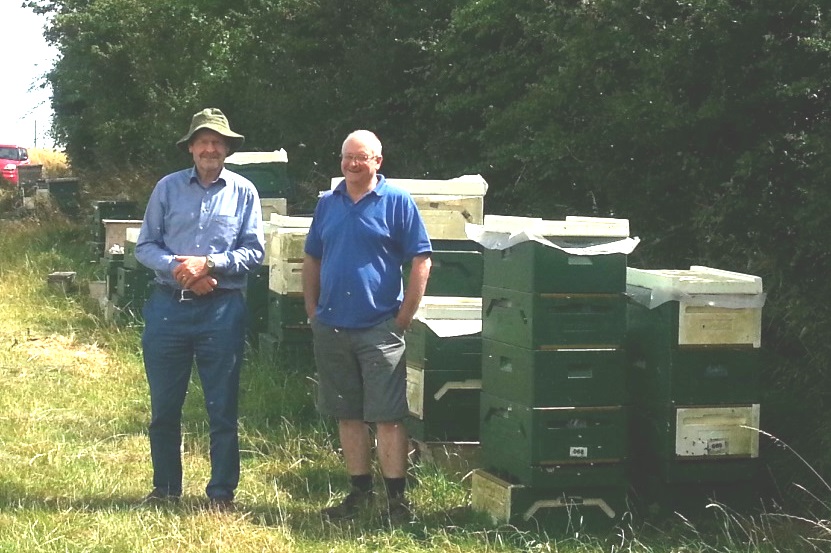
What would two strange looking men be doing in the middle of a field in Bedfordshire on a sunny afternoon in July? What else but inspecting bees, of course! But, where are the bee suits? Where is the smoker and the shower of bees around our heads? Why aren’t we being stung?

I should explain that these are Carniolan bees (Apis mellifera carnica) from the German Institut für Bienenkunde Celle and the chap wearing a hat is Prof. E.W. (Pim) Brascamp (a professor of genetics from Wageningen University in The Netherlands). He had come to inspect my bees as part of his role as supervisor of the Dutch BeeBreed group (www.beebreed.nl), of which, I am a member. The bees are known for their calm behaviour and productivity but they have been selectively bred over many generations to enhance these qualities still further. It may surprise you to learn that the colony just to my left (the one in 4 Langstroth deep boxes) went on to produce a yield of 133.4Kg (that’s almost 300lbs!) for the year.

My test queens are established in their own colonies during July and allowed to build up and over-winter without treatment of any kind. In the following spring, I begin assessing them using the protocols recommended by BeeBreed/AGT (AGT = Arbeitsgemeinschaft Toleranzzucht – The German varroa tolerance working group). These tests focus on a number of characteristics which are valuable to beekeepers (honey yield, aggression towards the examiner, stability on the comb, reluctance to swarming, over-wintering ability, spring build-up, in addition to varroa and disease resistance).

The test groups contain at least 8 sister queens mated with drones from daughters of a proven test queen on the island of Neuwerk in the Wadden Sea.

The first test involves monitoring the natural mite drop using an insert on the floor of the hive. Each week, for three successive weeks at the start of brood rearing, I count varroa mites that fall to the floor (the light coloured protonympths and males are not counted). This gives an initial assessment of the varroa load in the colony. Subsequent tests (pin-killed brood and soapy water wash which are carried out as spring develops into summer) indicate how well the infestation is managed by the colony.

The honey yield is an important consideration which is dependent upon the ability of the colony to over-winter well and build up quickly in the spring as well as the forage available. It is no good having a colony which builds up too late for the main nectar flow then wastes its energy in swarming during summer without providing a harvest. At the end of the queens first full year in the colony, I count the number of frames occupied by bees as the colony goes into winter cluster (around mid-October) then again at the first inspection in spring. Those that over-winter with over 90% of the colony alive in the spring are scored highest because these colonies are best placed to build up well in time for the oil seed rape (osr) flow.

At each inspection throughout the spring and summer, I assess the colony for aggressive tendencies, swarming intentions and their running/bunching behaviour. Obviously, this means I do not use smoke and often forget to even light my smoker. The average (mean) of all the scores given throughout the year is used by BeeBreed to calculate the breeding value for these traits (only colonies that show no swarming intentions at all can achieve maximum marks). They are compared to a five-year moving average for the entire Carniolan population (somewhere in the region of 7,000 queens) so, differences in local conditions can be evened out and only the best queens are selected for further propogation.

At three points in the year (the first up to 15th June, the second 16th June to 15th August, and the third after 15th August), I weigh the honey supers to show how much they have gathered from early sources (i.e. OSR/hedgerows), mid-season (beans, blackberries, etc) and late forage (at this time of year, we are looking at heather honey). These three sub-totals are added together to give the total yield which allows the colonies to be ranked for honey production purposes. My mean yield from my test colonies was 72.225Kg (~159lbs) with the highest performing colony yielding 133.4Kg (~293lbs) in 2015, so I didn’t do too badly.

I also take a sample of 50 drones and 50 workers as they emerge from their cells and keep them in a cage for a few days while their wings dry out. They are fed through the mesh by workers in the colony until I take them out and deep freeze them overnight to kill them. This sample is sent for morphometric testing to be sure that the progeny of my queens are pure Carniolans and that the mating was unaffected by other drones.

All of this information is entered into the BeeBreed database so my breeding supervisor can check it before the end of the year. At the start of February, the breeding values calculated from all of that data are announced and I can choose which queens to breed from. The following year, daughters of the selected queens are raised as queens and instrumentally inseminated with semen from drones of other tested queens. These groups of daughter queens join the test groups at my apiaries the following year.

I hope this brief introduction gives you an insight into the work that bee breeders do in order to provide you with good quality tested queens.

Paul Walton

You can take a horse to water

Water Source

In summer 2015, several Bedfordshire beekeepers were fortunate to be invited to take their bees to a local farm to pollinate a borage crop. It is important when providing bees for pollination that both bees and beekeepers are on their best behaviour! So, every effort was made to ensure the optimum ratio of colonies per hectare and hives were located around the crop to ensure even pollination. Hives were placed at mutually agreed sites, away from footpaths and out of the way of farm machinery. The farm gates were locked at night to prevent trespass, so there was good coordination between beekeepers and farmer to arrange vehicular access to deliver hives on agreed evenings when the crop was about to come into flower. Farmer and beekeepers all looked forward to a good yield. What could possibly go wrong…?

Well, a few hot summer days after moving the bees to the crop, we were told that there was a problem: On the farm are some horse paddocks, and the bees were drinking from the horse troughs and stinging the horses. It seemed that other water troughs around the farm were used by the bees to some extent, but bees were particularly attracted to the horse troughs. It is known that bees prefer almost any water source other than clean water.  Some of the horse troughs had a lot of green algae, maybe this was an attraction. The water in the horse troughs came from underground water courses, not off the mains; maybe this water contained mineral nutrients attractive to bees. Bees certainly like drinking from damp seed compost, presumably for the same reason. One horse trough had a dripping hose connection – the bees just loved this slow leak to drink from! Bees, as you know, are very clever and once they have found a water source, they remember the location and they mark it with Nasonov scent to attract other bees. Water carrier bees make multiple trips back and forth throughout the day; back in the hive, water is evaporated to reduce the temperature, used to dissolve crystallised stores or used in making brood food.

Literature on the bees and water problem did not seem very encouraging or helpful; it stressed that bees drinking at water sources where they were unwelcome (like swimming pools) is common, but difficult to address. Various attractants are suggested such as salt or urine but no specific advice is given about how much to add to water to make it really attractive to bees. Nevertheless, we felt we needed to try and resolve this problem and maintain good relationships with everyone. We made a plan, collected the materials and “ingredients” we needed and set off to tackle the problem; explaining the bees’ behaviour to the stable hands and asking for their help. The plan was to construct a pond for the bees to drink from, and at the same time, block access to the water troughs, so hopefully changing the bees drinking habits.

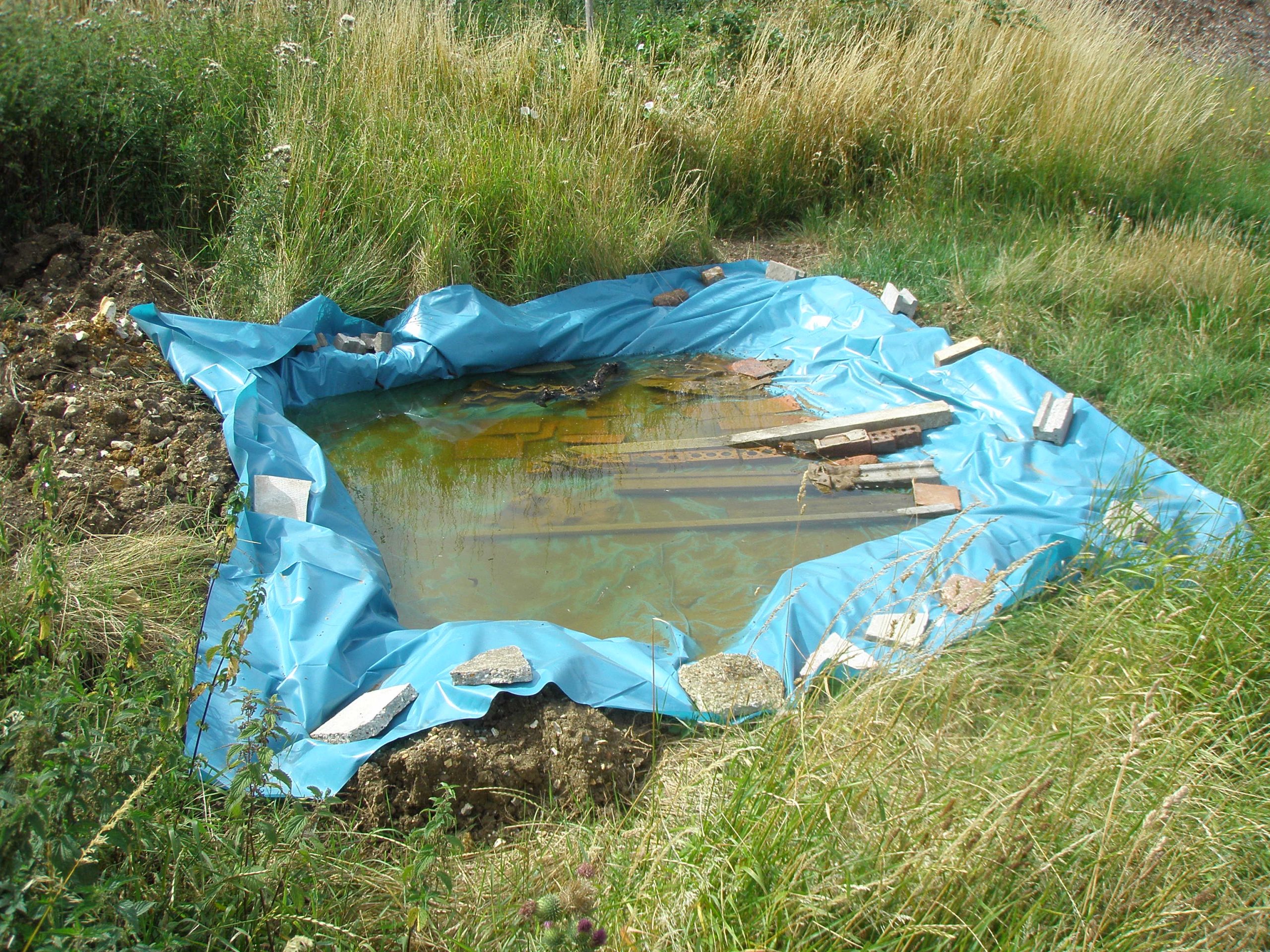
With the farmer’s agreement, the pond was built on a patch of uncultivated ground between the borage fields and the horse paddocks, roughly on the flight path of the water carrier bees. To construct the pond, the farm manager kindly scooped out a huge wedge of soil with a wide bucket on the front of his loader. The base of the hole was roughly 3m square, sloping from ground level at one side to about 50cm deep the other side. We spread out a 5m square of damp-proof membrane in this hole, leaving the surplus membrane around the edge to form a rainwater catchment area. We then put in water, together with all the ingredients which might attract bees to drink. We added salt, urine, compost, water from the horse troughs, also lemons and geraniums which are two of the constituents in Nazonov scent. We know bees prefer a damp surface to drink from rather than open water, so we laid various materials down the slope and into the water; concrete posts, roof tiles, bricks. We also floated wooden planks, upholstery foam and hessian sacking on the water surface. As an additional experiment we put out buckets of water with floating wooden landing platforms, each laced with a single additive, to see which of our ingredients attracted bees.

The stable hands scrubbed all the water troughs clean and covered them with wooden lids. We also supplied them with some almond scented bee repellent, “Bee Quick”, which they sprayed round the troughs. They carried big heavy plastic containers of water to the far side of the field for their horses. They told us the saying is true, “You can take a horse to water, but you can’t make it drink.” The horses didn’t like drinking from these plastic containers. Instead, they went back to the water troughs and kicked off the wooden lids. The lids were replaced and secured, forcing the horses to drink from their plastic containers. The most difficult horse trough to keep the bees off was the one with a dripping hose connection – Bee Quick did not seem to deter them in this instance; a new connection was needed.

That night there was a thunderstorm and heavy rain, which helped fill our pond.  The next day was cooler with puddles everywhere – no bees were seen drinking at all. However, several days later a few bees had started drinking from the pond, our plan seemed to be working! The stable hands – now fed up with carrying water and appreciating the huge volume a horse drinks – uncovered the clean drinking troughs and all seemed well. A couple of weeks later the pond was buzzing with bees, and wasps and flies. In the pond the bees’ preference was for drinking from hessian sacking and porous bricks. Our bucket experiment didn’t prove or disprove any of the theories, as the bees ignored them all. So much for scientific experiment on this occasion!  There’s more work still to be done to fully understand the water tastes of the honeybee.

Our pond was a success. We managed the bees’ behavior and re-trained their drinking habits. And we have maintained good relations with everyone at the farm. Beekeeping is never boring!

Gill Brewer & Colin Hall