Category: Article

Online Beginner Training Course

We offer this online, self-paced course. The course covers basic theory and handling of bees and comprises recordings of 8 sessions, each of approximately 1.5 hours duration, delivered by experienced beekeepers for a previous beginners training course. The course fee is £120 and includes access to the training, additional handout material and full membership of Bedfordshire Beekeepers Association until 31st December 2026.

For more details and how to join, see here.


Apiary Notes (February 2026) by Wally Thrale

We are at the critical point in winter with our colonies regards to food. If a colony has made it to this stage of winter it is likely that the queen is now laying eggs in greater numbers each day. This means the colony will now start to consume more of its stores so it is important to ensure it has sufficient stores to last until April.

Rather than heft a hive I prefer to take off the roof and lift the brood box as it gives me a better indication of the weight of stores that are left.

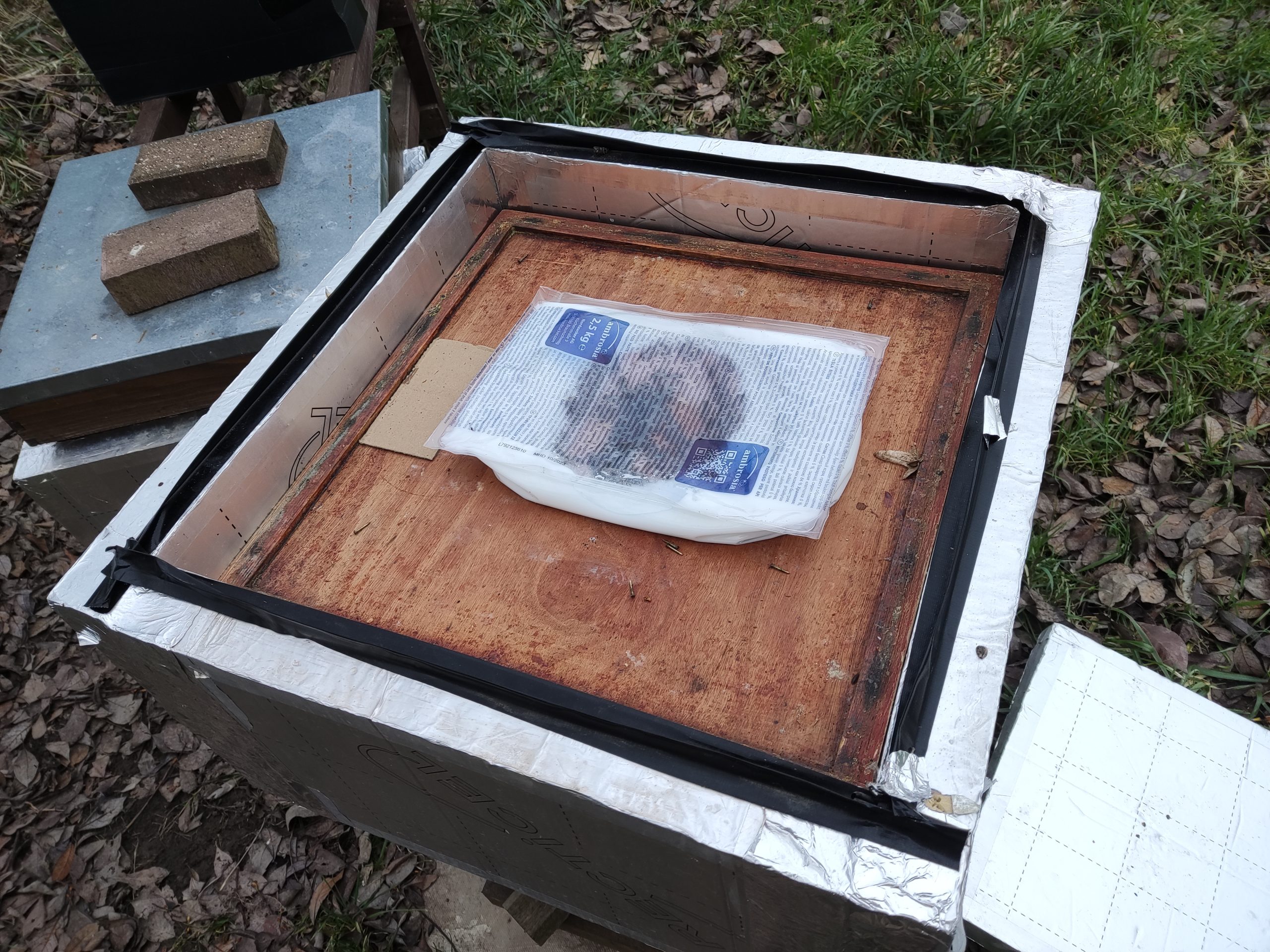
If a colony is light then it should be given a slab of fondant. Make a hole on one side of the block with a hive tool (the size of a 50p coin or slightly larger) and place the block directly over the bees. It may be necessary to use a shallow eke depending on depth of roof etc to accommodate the block. The Association stockist’s have plenty of fondant available for members.

At the time of writing the temperature outside is 4c but it is forecast to be in double figures by the weekend, possibly as high as mid-teens. So sugar syrup can be fed as daytime temperatures are on the rise. Small tray feeders are ideal for this job but do top them up if necessary – colonies will consume their stores quickly in the coming weeks.

Looking at my bees recently some of them have come through winter quite strongly. At some point in March these colonies will need a super to allow for bee numbers. However, place the queen excluder and super above the crown board as the bees will probably go down into the brood box overnight to maintain heat for the brood. Using this configuration causes less disturbance as the crown board remains in place keeping the heat in. The super can be used during the day if the brood box becomes too warm or congested. Later, when the daytime temperature is higher, move the queen excluder to its position on top of the brood box.

2026 Beginner Training Courses – Open for Booking

Our beginner/new beekeeper training courses cover basic theory and handling of bees and are delivered by experienced beekeepers. They comprise a theory based course in the early spring, followed by practical hands-on experience in our training apiaries throughout the beekeeping season.

The classroom based courses are given in the January-March timeframe:

  1. Luton Course: a series of 6 classroom based sessions at the Discovery Centre, Stockwood Park, Luton on Sunday mornings.
  2. Bedford Course: a series of 6 classroom based sessions at Moggerhanger Village Hall on Wednesday evenings.

Practical experience can be gained in our training apiaries in Luton and Bedford.

For more detail and how to join, click here.

2026 Beginner Training Courses.

Our beginner/new beekeeper training courses cover basic theory and handling of bees and are delivered by experienced beekeepers. They comprise a theory based course in the early spring, followed by practical hands-on experience in our training apiaries throughout the beekeeping season.

The classroom based courses are given in the January-March timeframe:

  1. Luton Course: a series of 6 classroom based sessions at the Discovery Centre, Stockwood Park, Luton on Sunday mornings.
  2. Bedford Course: a series of 6 classroom based sessions at Moggerhanger Village Hall on Wednesday evenings.

Practical experience in our training apiaries in Luton and Bedford is included.

The 2026 classroom courses are now at or nearing completion and no longer open to new joiners.

However, we will be offering a self-paced online course from about end of March.

For more detail and how to join, click here.

2025 Yellow-Legged Asian Hornet Week – Update from Peter Davies (NBU)

This update from Peter Davies, Operational Delivery Lead at the National Bee Unit, was hosted by the British Beekeepers Association on Tuesday 2nd September 2025. A recording of the session can be found here.

The following are the key points:

  • Eradication phase continues.
  • 343 credible sightings (out of 13,000 reports)
  • 87 nests confirmed (majority destroyed, rest in progress)
  • Trial of micro-transmitters fitted to hornets – nests found in less than an hour
  • Beekeeping association Asian Hornet Teams (AHTs) provide useful support
  • We need to continue vigilance, awareness, identification, reporting.

Monitoring

  • NBU advice is that, in areas that are not at high or medium risk of YLH presence (like Beds), do not use kill traps as they have big impact on by-catch.
  • Preferably, use open monitoring i.e wick stations.
  • Selective traps that have no/limited by-catch (e.g. Gard’Apis or VespaCatch with 6.5mm escape holes) are OK if properly used and monitored.
  • Monitoring need varies with season and local risk level (proximity to any previous years’ nests); so selective and killing traps are  ideally to be used only near areas where there are confirmed sightings.
  • NBU guidance on monitoring can be found here.
  • More information on the YLH can be found here.


Yellow-Legged Hornet – NBU Update

Nigel Semmence from the National Bee Unit (NBU) gave an update on the yellow-legged Asian hornet (YLH) situation on Tuesday 11th March.

The following are the key points:

2024

  • 24 nests destroyed – South East England.
  • First evidence of overwintering/breeding in UK.
  • 29,611 reports but only 71 confirmed – 0.2%. We need to continue to educate the public on how to identify the YLH.

2025

  • Eradication phase continues.
  • 1 confirmed single hornet – January – Oswestry, Shropshire.
  • Spring YLH queen surveillance has been approved for the NBU – they are monitoring 5 km zones around 7 high risk points identifiied in Kent/E. Sussex.
  • We need to continue vigilance, awareness, identification, reporting.

Monitoring

  • NBU advice is that, in areas that are not at high or medium risk of YLH presence (like Beds), do not use kill traps as they have big impact on by-catch.
  • Preferably, use open monitoring i.e wick stations.
  • Selective traps that have no/limited by-catch (e.g. Gard’Apis or VespaCatch with 6.5mm escape holes) are OK if properly used and monitored.
  • Monitoring need varies with season and local risk level (proximity to any previous years’ nests); so selective and killing traps are  ideally to be used only near areas where there are confirmed sightings.
  • NBU guidance on monitoring can be found here.

2025 Beginner Training Courses – Open for Booking

Our beginner/new beekeeper courses cover basic theory and handling of bees and are delivered by experienced beekeepers. They comprise a theory based course in the early spring, followed by opportunity for practical hands-on experience in our training apiaries throughout the beekeeping season.

The classroom based courses are given in the January-March 2025 timeframe:

  1. Luton Course: a series of 5 classroom based sessions at the Discovery Centre, Stockwood Park, Luton on Sunday mornings.
  2. Bedford Course: a series of 6 classroom based sessions at Moggerhanger Village Hall on Wednesday evenings.

Practical experience can be gained in our training apiaries in Luton and Bedford.

For more detail and how to join, click here.


Asian Hornet Week, 2-8th September 2024

This week has been designated by the British Beekeepers Association (BBKA) as Asian Hornet Week. The intention is to increase public awareness of the threat that this voracious insect poses to our pollinators and, in particular, to encourage accurate identification and reporting. By end of July 2024, over 22,000 reported sightings were incorrect and only about 60% of sighting reports included a photo which is vital for confirmation.

To that end, the BBKA have provided the following which we encourage beekeepers and members of the public to read and to help distribute: