Category: Public

2026 Honey Show

Our annual Honey Show, run to National Honey Show rules, is where beekeepers and others submit their honey, wax items, cookery and craft items related to bees and beekeeping for judging by experienced judges, with rosettes and trophies awarded to winners. There are entry classes not only for our members but also for other beekeepers and the public.

For more information see here.

Apiary Notes (February 2026) by Wally Thrale

We are at the critical point in winter with our colonies regards to food. If a colony has made it to this stage of winter it is likely that the queen is now laying eggs in greater numbers each day. This means the colony will now start to consume more of its stores so it is important to ensure it has sufficient stores to last until April.

Rather than heft a hive I prefer to take off the roof and lift the brood box as it gives me a better indication of the weight of stores that are left.

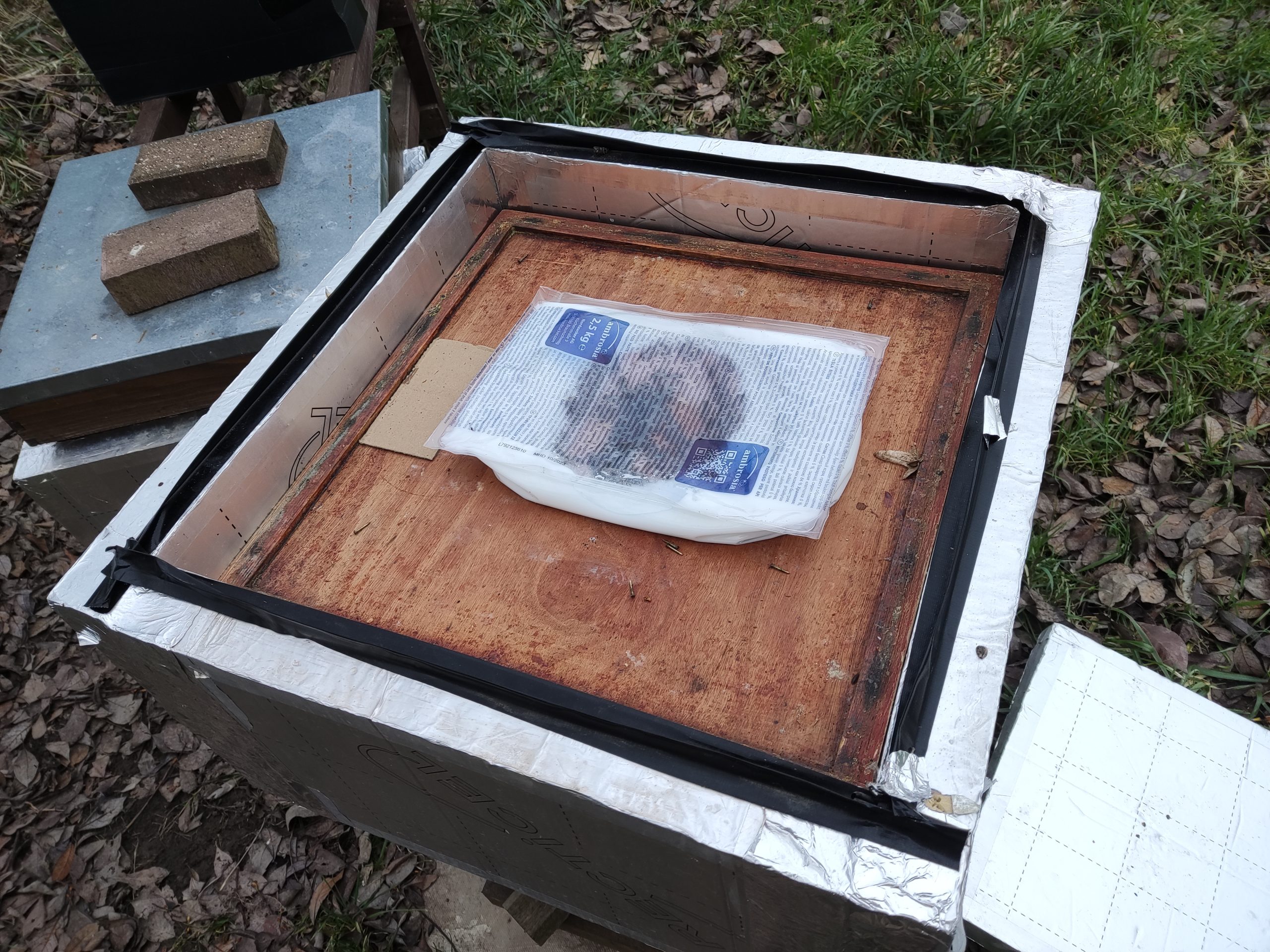
If a colony is light then it should be given a slab of fondant. Make a hole on one side of the block with a hive tool (the size of a 50p coin or slightly larger) and place the block directly over the bees. It may be necessary to use a shallow eke depending on depth of roof etc to accommodate the block. The Association stockist’s have plenty of fondant available for members.

At the time of writing the temperature outside is 4c but it is forecast to be in double figures by the weekend, possibly as high as mid-teens. So sugar syrup can be fed as daytime temperatures are on the rise. Small tray feeders are ideal for this job but do top them up if necessary – colonies will consume their stores quickly in the coming weeks.

Looking at my bees recently some of them have come through winter quite strongly. At some point in March these colonies will need a super to allow for bee numbers. However, place the queen excluder and super above the crown board as the bees will probably go down into the brood box overnight to maintain heat for the brood. Using this configuration causes less disturbance as the crown board remains in place keeping the heat in. The super can be used during the day if the brood box becomes too warm or congested. Later, when the daytime temperature is higher, move the queen excluder to its position on top of the brood box.

2025 Honey Show and Festival

Our annual Honey Show, run to National Honey Show rules, is where beekeepers and others submit their honey, wax items, cookery and craft items related to bees and beekeeping for judging by experienced judges, with rosettes and trophies awarded to winners. There are entry classes not only for our members but also for other beekeepers and the public.

Our Honey Festival (10.30am to 4pm) is a fun day for all with stalls and talks throughout the day. Tasting and sales of local honey are always popular. There will be live bees on display, children’s crafts, candle rolling, talks such as “So You Want To Be A Beekeeper” and “Gardening For Bees”. Do come along, we would love to see you.

See the Honey Show page for more details including how to enter

2025 Beginner Training (Bedford)

This course is suitable for beginners and new beekeepers. 

A series of 6 classroom based sessions will be held at Moggerhanger Village Hall on Wednesday evenings from 7.30 to 10.00pm covering basic theory; a break for coffee/tea is included. The 2025 course starts on Wednesday 29th January with subsequent sessions on the 12th, 19th, 26th Feb and the 12th, 19th March (note not consecutive weeks due to venue availability).

Once the weather improves, we move outside to our training apiary for practical experience throughout the spring and summer. Practical sessions are held on Sunday mornings at Priory Country Park (weather permitting).

The course fee (£98) includes all classroom and practical sessions as well as full membership of Bedfordshire Beekeepers Association until the end of 2025.

To join the Bedford course, use this link.

Note that we also run a course in the Luton area – see here.

Online Talk – Rational Varroa Control by Professor David Evans

Don’t miss out! Get your free ticket for another talk by one of our favourite speakers – Prof David Evans. Click here to get a ticket:

Varroa remains the greatest threat to bees and beekeeping. The mite, and the viruses it transmits, are responsible for most overwintering colony losses. To avoid these mite levels must be minimised. This presentation discusses some of the science behind why Varroa and viruses are a threat to our bees before moving on to practical beekeeping considerations including how and when to control Varroa in your hives. Many beekeepers treat at the wrong time of the season, or use the wrong treatment, for maximal effect. In addition to a late summer and midwinter treatment (which should be all that are needed for successful Varroa management) the opportunities to treat in the middle of the season, the importance of managing Varroa in swarms and the strategic, landscape-scale, management of Varroa are also discussed.

Bedfordshire Beekeepers’ Association’s Honey Show and Festival

Our annual Honey Show, run to National Honey Show rules, is where beekeepers and others submit their honey, wax items, cookery and craft items related to bees and beekeeping for judging by experienced judges, with rosettes and trophies awarded to winners. There are entry classes not only for our members but also for other beekeepers and the public. See here for details.

Our Honey Festival (11am to 4pm) is a fun day for all with stalls and talks throughout the day. Tasting and sales of local honey are always popular. There will be live bees on display, facepainting, apple pressing, candle rolling and more. Talks will include “The Secret Life of Bees”, “Mead Making”, “So You Want To Be A Beekeeper” and “Gardening For Bees”.

Do come along, we would love to see you.

The BBKA Asian Hornet Conference 17th February 2024

This conference provided an overview of the effect of the hornet in 2023 and plans for dealing with it in 2024.

You can view a recording on YouTube here. Best to start from about 9 minutes from the beginning.

Nigel Semmence: ‘An Update from the NBU’
Contingency Planning and Science Officer, National Bee Unit

Martin Smith; eR2 Project Manager: ‘Communication is the key’
An introduction to the way in which we beekeepers fit into the fight against the Asian Hornet.  Following on from the NBU update, this talk will confirm the roles of AH Coordinators and Verifiers and how they appear on the various maps that are now available, both publicly and within the secure eR2 membership environment. It will also outline the way in which a suspect sighting reported by a member of the public via the AH App will be passed as quickly as possible to a beekeeper to follow up.

Kirsteen Thorne;  BBKA Outreach Officer
Kirsteen has previously worked as a journalist, presenter and radio producer for BBC Radio Norfolk and the regional BBC Look East programme. Initially she will be focusing on raising the profile of the threat of Asian Hornet and implementing the BBKA outreach plan.

Alastair Christie:  ‘An update on Jersey and what BBKA could learn from the Jersey Experience’ 
Alastair Christie works for the Environment Department with the Government of Jersey as an Invasive Species Officer. He has been in post as Jersey’s Asian Hornet Coordinator since 2019 managing the control programme and working closely with the volunteers who carry out much of the work. As such he has built up considerable experience of the invasive Asian hornet (Vespa velutina nigrithorax) and has seen how the hornet landscape has changed over the years, and how their techniques for controlling them have evolved and been refined. In 2023 they have found a record 339 nests, up from 174 in 2022. In his lecture he’ll bring you up to date on what happened in 2023 in Jersey, some of the lessons that others can learn.

Jackie Thomas of Dover and District BKA: “An update from Kent”

Jackie relates the experience and lessons learned by DDBKA in 2023. DDBKA have developed a simple and sustainable way of utilising members to perform widespread monitoring.


Learn about the Asian Hornet Threat

The Yellow-Legged Asian Hornet (Vespa velutina)

Defra update 03.11.23 – So far in 2023 there have been 71 Asian hornet nests found in 55 locations.

The Asian hornet is the biggest threat to honey bees since the Varroa mite came to our shores. It can also have a devastating effect on other insects (butterflies, bumble bees etc).

Beekeepers and the public are encouraged to install the Asian Hornet Watch app (available from Google Play Store/Apple App Store) on their mobile phones to be able to report any credible sightings of the Asian hornet to the authorities. Photos or a specimen are essential to get your report seriously considered.

Acknowledgements: The information provided has been drawn from various public sources including DEFRA, the Animal & Plant Health Agency, the National Bee Unit, the British Beekeepers Association and the Non Native Species Secretariat.

1        Asian vs European hornet

Vespa velutina (or the yellow legged hornet) is smaller than our native European hornet (Vespa crabro) and distinguishable by its yellow tipped legs, its dark abdomen with an orange/yellow fourth segment and its size. The queen (or gyne) is about 30mm long and the workers are slightly smaller at 25mm.

The European hornet with its larger size, powerful jaws and thick exoskeletons makes direct attacks on a hive whereas the Asian Hornet must rely on another method of attack that gives beekeepers some rather different problems – it uses its aerial agility to hawk bees in preference to a direct attack on the hive which is why Asian hornets are called solitary hawkers. However, later in the beekeeping season they may make a direct attack on hives usually on weaker colonies.

To compare the Asian hornet to the European…it is smaller and looks different, but its nests (yes – plural – they can make more than one nest) are 3-4 times more populous, they are more aggressive and their active season is much longer.

2        The Asian hornet lifecycle:

2.1        Spring

After winter hibernation, the queen emerges and seeks out sugary food (carbs) in order to build energy to commence building a nest known as the primary nest. This “foundress queen” makes and looks after this nest by herself. You can see a photo of a primary nest here – they are small and often built in urban areas under eaves. It has been noted that the hornet favours building a new nest in the vicinity of an existing old nest from the previous year.

At this stage, she is alone and vulnerable to attack from birds, being trapped or being killed by another queen but she rapidly lays eggs to produce the future workforce. As the colony increases, a larger nest is needed. They may expand the primary nest or build a secondary (main) nest near to the primary nest. The bulk of the workers move to build the main nest and are later joined by the queen and other workers. So if you find a nest with no eggs or Queen, there will be a main nest nearby.

2.2        Summer

During this period a single colony can produce 6000 individuals in one season. From July onwards, the hornet predates on honeybee colonies. Predation (hawking, waiting outside hives for returning foragers) increases and lasts through to the end of November. During late September – early October our honey bees are raising the winter brood that will take the colony through winter so any losses reduce the colony’s ability to survive. It has been estimated that 4 hornets outside a hive creates c40% reduction in honey bee foraging, 6 a c60% reduction and 12 hornets hawking outside a hive means NO foraging at all causing undue stress to the bees. As hawking continues, the honey bee colonies reinforce their guards as the colony starts to get stressed, and in the absence of food coming in, the colonies will take their queen off lay but they may also kill her; thereby, the cohesion and organisation of the colony starts to collapse. During September, absconding has been reported in Europe in heavily predated areas. Once an apiary is found, the hornets learn waymarks to find it again, driven by the smell of pollen, honey, and the honey bees Nasonov gland pheromones.

2.3        Autumn

During Autumn, the priorities of the Asian hornet shift from foraging and nest expansion to producing gynes (queens) and males for mating. However, only a small number of potential foundress queens will successfully mate and make it through the winter (<10%). The newly mated queens find somewhere to hibernate for winter, whilst the old queen and the other hornets die, leaving an empty nest. At this time of year, the hornet may also make direct attacks on hives. The following Spring, the process starts all over again.

3        What can we do?

“Inaction and lack of knowledge on the part of the beekeeper and the public are two of the Asian hornet’s greatest allies”.

Be observant. A single hornet can fly 20-30kms per day and with a favourable wind even further so they can quickly populate new areas.  In Jersey, where the hornet now seems established, most sightings are reported by the public. It has been found that there can be more hornets in urban and suburban areas rather than rural ones. However, it does mean there can be many more opportunities to spot them.

Report sightings. Your role is to spot the Asian hornet and report it. Download the Asian Hornet Watch app – this is how beekeepers and the public should report any sightings.

Educate and encourage beekeepers and the public to be aware and observant. We have identification posters and leaflets that can be put up on Community notice boards and in village halls, visitor centres etc. Contact our Asian Hornet Coordinator (phill_howes@icloud.com) to request them.

Use monitoring traps. Where possible, in spring (from late February to end of May),  use monitoring traps in gardens, school grounds, garden centres etc as well as around apiaries. See the APHA link in section 4 below for information on monitoring traps.  To minimise the affect on other insects, use non-killing traps and regularly (ideally daily) inspect so you can release other insects. Note it is illegal to free a trapped Asian hornet.

Spotted an Asian hornet nest? Asian hornets defend their nests aggressively. Do not attempt to destroy an Asian hornet nest – a bee suit will not protect you. Use the Asian Hornet Watch app to report it.

For beekeepers:

  • They may not be in our area yet but that could happen at any time and you need to be prepared.
  • Defence is all about putting the right measures in place at the right time; that requires knowing the hornet’s life-cycle and the measiures available to combat it (see links in section 4 below esp Andrew Durham’s videos)
  • Sick bees are in no shape to fight off the Asian hornet so practice good apiary hygiene
  • Bees with high varroa levels are compromised so treat for varroa
  • Selective trapping. Make or buy non-killing monitoring traps, get them in place from early Spring (late February) to end May to help trap queens and limit nest building. Monitoring should continue through to November during the season when large populations of the hornet are present and captures/sightings more likely. Monitor traps frequently so that any other species trapped can be released.  The APHA link below gives options for traps.
  • Should hornets be present, make sure your apiary environment favours the bees not the hornets:
    • Don’t draw attention to the hives, keep olefactory signature low e.g. don’t have hives open too long,  etc.
    • Grow grass in front of the hives so the bees have somewhere to hide.
    • Close off the sides and under landing boards, use a solid floor or close off the open mesh floor as hornets hawk underneath hives and stress the bees. French beekeepers add skirts to their hives blocking the access from under the hive to the entrance or build a wide access ‘conservatory’ to the entrance, hence shielding the bees from surprise attack.
    • Single/weak hives are vulnerable so consider uniting weak ones and maintain several strong colonies.
    • Try early morning/dusk feeding and inspections (the hornets return to their nest for darkness).

4       Additional information …

We have given a simple overview above. For more detailed information, you can use the links below. There is some great information on the websites of the British Beekeepers Association (BBKA), the National Bee Unit (NBU) and the Non Native Species Secretariat (NNSS).

We encourage you to watch Andrew Durham’s excellent talks on You Tube.

Andrew Durham videos:

Part 1: https://www.youtube.com/live/mx3LhC2fnoc?si=tI78GJ531pdiClR0  (start ca 20 mins in)

Part2: https://www.youtube.com/live/9SNvrq7oNBY?si=LlFrYsSbnWJRSWJo  (start ca 13 mins in)

BBKA Asian Hornet Week videos:

https://www.bbka.org.uk/asian-hornet-week

Non-Native Species Secretariat general info inc on AH:

https://www.nonnativespecies.org/home/index.cfm

APHA video on making an Asian hornet monitoring trap:

https://youtu.be/CR6MUekAjMo?si=XMVPPAfO02YZpSq9

Somerset BKA video on setting up an AHAT team:

https://youtu.be/NtSjcGP-zj8?si=-Jb_cH8hQP4CKl4g

NBU Latest Asian Hornet News

https://www.nationalbeeunit.com/about-us/beekeeping-news/2023-asian-hornet-rolling-updates/

A useful book:

https://www.asianhornethandbook.com/