Category: Article

Learn about the Asian Hornet Threat

The Yellow-Legged Asian Hornet (Vespa velutina)

Defra update 03.11.23 – So far in 2023 there have been 71 Asian hornet nests found in 55 locations.

The Asian hornet is the biggest threat to honey bees since the Varroa mite came to our shores. It can also have a devastating effect on other insects (butterflies, bumble bees etc).

Beekeepers and the public are encouraged to install the Asian Hornet Watch app (available from Google Play Store/Apple App Store) on their mobile phones to be able to report any credible sightings of the Asian hornet to the authorities. Photos or a specimen are essential to get your report seriously considered.

Acknowledgements: The information provided has been drawn from various public sources including DEFRA, the Animal & Plant Health Agency, the National Bee Unit, the British Beekeepers Association and the Non Native Species Secretariat.

1        Asian vs European hornet

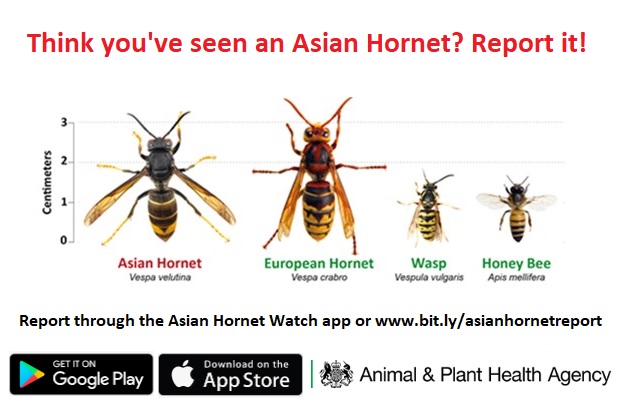
Vespa velutina (or the yellow legged hornet) is smaller than our native European hornet (Vespa crabro) and distinguishable by its yellow tipped legs, its dark abdomen with an orange/yellow fourth segment and its size. The queen (or gyne) is about 30mm long and the workers are slightly smaller at 25mm.

The European hornet with its larger size, powerful jaws and thick exoskeletons makes direct attacks on a hive whereas the Asian Hornet must rely on another method of attack that gives beekeepers some rather different problems – it uses its aerial agility to hawk bees in preference to a direct attack on the hive which is why Asian hornets are called solitary hawkers. However, later in the beekeeping season they may make a direct attack on hives usually on weaker colonies.

To compare the Asian hornet to the European…it is smaller and looks different, but its nests (yes – plural – they can make more than one nest) are 3-4 times more populous, they are more aggressive and their active season is much longer.

2        The Asian hornet lifecycle:

2.1        Spring

After winter hibernation, the queen emerges and seeks out sugary food (carbs) in order to build energy to commence building a nest known as the primary nest. This “foundress queen” makes and looks after this nest by herself. You can see a photo of a primary nest here – they are small and often built in urban areas under eaves. It has been noted that the hornet favours building a new nest in the vicinity of an existing old nest from the previous year.

At this stage, she is alone and vulnerable to attack from birds, being trapped or being killed by another queen but she rapidly lays eggs to produce the future workforce. As the colony increases, a larger nest is needed. They may expand the primary nest or build a secondary (main) nest near to the primary nest. The bulk of the workers move to build the main nest and are later joined by the queen and other workers. So if you find a nest with no eggs or Queen, there will be a main nest nearby.

2.2        Summer

During this period a single colony can produce 6000 individuals in one season. From July onwards, the hornet predates on honeybee colonies. Predation (hawking, waiting outside hives for returning foragers) increases and lasts through to the end of November. During late September – early October our honey bees are raising the winter brood that will take the colony through winter so any losses reduce the colony’s ability to survive. It has been estimated that 4 hornets outside a hive creates c40% reduction in honey bee foraging, 6 a c60% reduction and 12 hornets hawking outside a hive means NO foraging at all causing undue stress to the bees. As hawking continues, the honey bee colonies reinforce their guards as the colony starts to get stressed, and in the absence of food coming in, the colonies will take their queen off lay but they may also kill her; thereby, the cohesion and organisation of the colony starts to collapse. During September, absconding has been reported in Europe in heavily predated areas. Once an apiary is found, the hornets learn waymarks to find it again, driven by the smell of pollen, honey, and the honey bees Nasonov gland pheromones.

2.3        Autumn

During Autumn, the priorities of the Asian hornet shift from foraging and nest expansion to producing gynes (queens) and males for mating. However, only a small number of potential foundress queens will successfully mate and make it through the winter (<10%). The newly mated queens find somewhere to hibernate for winter, whilst the old queen and the other hornets die, leaving an empty nest. At this time of year, the hornet may also make direct attacks on hives. The following Spring, the process starts all over again.

3        What can we do?

“Inaction and lack of knowledge on the part of the beekeeper and the public are two of the Asian hornet’s greatest allies”.

Be observant. A single hornet can fly 20-30kms per day and with a favourable wind even further so they can quickly populate new areas.  In Jersey, where the hornet now seems established, most sightings are reported by the public. It has been found that there can be more hornets in urban and suburban areas rather than rural ones. However, it does mean there can be many more opportunities to spot them.

Report sightings. Your role is to spot the Asian hornet and report it. Download the Asian Hornet Watch app – this is how beekeepers and the public should report any sightings.

Educate and encourage beekeepers and the public to be aware and observant. We have identification posters and leaflets that can be put up on Community notice boards and in village halls, visitor centres etc. Contact our Asian Hornet Coordinator (phill_howes@icloud.com) to request them.

Use monitoring traps. Where possible, in spring (from late February to end of May),  use monitoring traps in gardens, school grounds, garden centres etc as well as around apiaries. See the APHA link in section 4 below for information on monitoring traps.  To minimise the affect on other insects, use non-killing traps and regularly (ideally daily) inspect so you can release other insects. Note it is illegal to free a trapped Asian hornet.

Spotted an Asian hornet nest? Asian hornets defend their nests aggressively. Do not attempt to destroy an Asian hornet nest – a bee suit will not protect you. Use the Asian Hornet Watch app to report it.

For beekeepers:

  • They may not be in our area yet but that could happen at any time and you need to be prepared.
  • Defence is all about putting the right measures in place at the right time; that requires knowing the hornet’s life-cycle and the measiures available to combat it (see links in section 4 below esp Andrew Durham’s videos)
  • Sick bees are in no shape to fight off the Asian hornet so practice good apiary hygiene
  • Bees with high varroa levels are compromised so treat for varroa
  • Selective trapping. Make or buy non-killing monitoring traps, get them in place from early Spring (late February) to end May to help trap queens and limit nest building. Monitoring should continue through to November during the season when large populations of the hornet are present and captures/sightings more likely. Monitor traps frequently so that any other species trapped can be released.  The APHA link below gives options for traps.
  • Should hornets be present, make sure your apiary environment favours the bees not the hornets:
    • Don’t draw attention to the hives, keep olefactory signature low e.g. don’t have hives open too long,  etc.
    • Grow grass in front of the hives so the bees have somewhere to hide.
    • Close off the sides and under landing boards, use a solid floor or close off the open mesh floor as hornets hawk underneath hives and stress the bees. French beekeepers add skirts to their hives blocking the access from under the hive to the entrance or build a wide access ‘conservatory’ to the entrance, hence shielding the bees from surprise attack.
    • Single/weak hives are vulnerable so consider uniting weak ones and maintain several strong colonies.
    • Try early morning/dusk feeding and inspections (the hornets return to their nest for darkness).

4       Additional information …

We have given a simple overview above. For more detailed information, you can use the links below. There is some great information on the websites of the British Beekeepers Association (BBKA), the National Bee Unit (NBU) and the Non Native Species Secretariat (NNSS).

We encourage you to watch Andrew Durham’s excellent talks on You Tube.

Andrew Durham videos:

Part 1: https://www.youtube.com/live/mx3LhC2fnoc?si=tI78GJ531pdiClR0  (start ca 20 mins in)

Part2: https://www.youtube.com/live/9SNvrq7oNBY?si=LlFrYsSbnWJRSWJo  (start ca 13 mins in)

BBKA Asian Hornet Week videos:

https://www.bbka.org.uk/asian-hornet-week

Non-Native Species Secretariat general info inc on AH:

https://www.nonnativespecies.org/home/index.cfm

APHA video on making an Asian hornet monitoring trap:

https://youtu.be/CR6MUekAjMo?si=XMVPPAfO02YZpSq9

Somerset BKA video on setting up an AHAT team:

https://youtu.be/NtSjcGP-zj8?si=-Jb_cH8hQP4CKl4g

NBU Latest Asian Hornet News

https://www.nationalbeeunit.com/about-us/beekeeping-news/2023-asian-hornet-rolling-updates/

A useful book:

https://www.asianhornethandbook.com/

July 2023 Apiary Notes from Wally Thrale

Now we are in July it is the time when wasps tend to make their appearance around our colonies. Being prepared is better than trying to stop wasps once they have targeted a hive. It is a good idea to reduce entrances down to around an inch or so, smaller than this for nucs. Once wasps have found a way into a hive it is very difficult to stop them. They can easily take out a weak colony or nuc in a short time. They then move on to the next target. Do get the foam ready and apply soon.

Swarming in my area was very busy until a week or so ago. Hopefully most colonies have finished with that now but the occasional one will consider swarming. Now we are past the longest day of the year bees tend to recognise this and realise they need to have enough stores for winter.

At the end of the season (typically end of July to early August) there are often super frames that are not capped over as the bees are waiting or hoping for another nectar flow. By having local knowledge of the local flora we will know if another flow is likely or not. It is best to leave supers on the hive for a few days when a flow has finished to allow time for the bees to ripen the latest batch.

Uncapped frames can be extracted but do the ‘shake’ test first. Hold the frame firmly with one side facing downwards and give a good shake. If no honey falls out it is safe to extract the frame. If honey does fall out put these frames back into a separate super and return to the bees for a few days, where they will finish ripening the honey.

To remind you, the Association has several extractors around the county which can be borrowed at no cost. Obviously, they may be in demand around early August so be aware that you may have to wait a little while.

Many beekeepers treat for varroa in August which means no honey should be present. Do have your treatments ready to use as some of them are time and temperature critical. If they are not applied as per instructions they are barely effective. This is a waste of money but will also compromise the colony as the winter bees will not be in good condition. Winter bees need to be healthy (and lots of them) for a colony to survive to next spring. Varroa was probably a cause for some of the large losses last winter.

Next Tuesday (4th July) we will run a Zoom session to talk over any of these points or anything else you may wish to ask. The invitation will be sent out nearer the time.

Finally, it is not too late to make nucs to overwinter and this is something all beekeepers should try to do in case of a bad winter. I have in stock two brand new polynucs the Association bought a while back. If you want to purchase one please get back to me – they cost £58.

June 2023 Apiary Notes from Wally Thrale

We are now half way through the active beekeeping season. Looking at the state of colonies as they came out of winter it was hard to see how they could build up in time for the OSR crop. But bees are amazing at expanding rapidly in spring if they have enough forage, even in this spring which has not been kind to bees.

Swarming is in full swing judging by my bees and the number of swarm calls I have received. This year we have tried to carry out pre-emptive artificial swarms on colonies to save time on subsequent inspections. The process was to find the queen and place her in an empty brood box on the original site and add a couple of frames of sealed brood. This brood is important as it provides plenty of nurse bees for the queen when they emerge. Frames of foundation were then added to make up the required number of frames plus some drawn comb if available. The box containing the brood was moved to one side and given a floor, roof and frames of foundation. This box will make emergency queen cells and, at the next inspection 7 days later, one sealed queen cell is left after knocking down all the others. It will be at least a month after the initial process was carried out before the new queen comes into lay but it may be necessary to provide a super to the hive to cater for the emerging brood (and honey hopefully).

Another way of slowing a colony down is to take a few frames of brood and place them into a nuc. Nucs are so important and we all should over winter some, preferably in polynucs. Winter losses for last year were high and quite a few people sadly lost all their bees. Nucs build up really well if transferred into a full box in early spring. We placed several nucs on OSR and they have produced a good crop, not far behind that overwintered full colonies. These nucs will also make emergency queen cells and again, inspect after a week and leave one good looking queen cell. Leaving many can allow a swarm to emerge from the artificial swarm or nuc. For nucs I prefer to move them to another apiary to avoid losing too many flying bees back to the parent colony. For a conventional artificial swarm this is less of worry as nearly all the bees in the box containing the brood remain there after the splitting.

There is far less OSR grown these days because of the neonic ban. However, if you had bees near a crop of rape it is important to extract soon as it will start to granulate quickly. So tomorrow the extractor will be in use for the first time this year. Hopefully it will spin easily and empty buckets can start to fill up.

The Association has extractors available to borrow but remember many people will want to extract around this time so best to put your name down if you want to make use of one. See the Yearbook for members who look after extractors.

Sometimes there is a shortage of nectar in June so do check your bees have enough stores to tie them over to summer flow.

Regards
Wally

April 2023 Apiary Notes from Wally Thrale

We are approaching April and the weather is not being kind, so there is not much opportunity to carry out real beekeeping other than to be prepared for when the weather improves.

On the first inspection it is important to evaluate the strength of each colony. For example, this week I moved two hives that appeared queen right (plenty of pollen being collected) but one hive had many more bees than the other. So the boxes were physically swapped; the strong colony was placed in the spot of the weak one and the weaker one to where the strong hive was positioned. This meant that when bees from the strong colony left the hive they would return to the weaker one and thereby boost its numbers. By the same token the strong colony is depleted of bees and held back for a while. A quick look under the crown board is enough to determine the strength of colonies and therefore it easy to make these assessments. The bees don’t seem to mind strangers appearing their hive as they aren’t entering in ‘robbing mode’.

If you are lucky to have a colony on the stronger side, that is almost a full brood box of bees, place a super over the crown board. This allows room for bees to expand during warm days but also allows them to keep the brood warm overnight. When most of the super contains bees it is time to move it below the crown board. Note – it is a good idea to over super in spring, that is always placing an empty super above the ones that are below the crown board. Bees might need the space for honey and we are optimists!

When it is possible to carry out a proper inspection (and I like the temperature to be around at least 17/ 18c for the bees sake), my main priority is to find, mark and clip a wing of the queen. This is best time to do this task as the colony is still relatively small, many bees are foraging and there are probably not too many drones around. This last point makes it easier to spot the queen as drones can distract the eye when looking for the main bee. The other consideration on this inspection is to look at the brood:

  1. a)      Is there a good brood pattern?
  2. b)      Does the brood look healthy?
  3. c)       Is there plenty of space for the queen to lay? If there are too many frames of stores replace some with empty drawn ones. But make sure they have stores to last till the next inspection.

The first inspection is also a good time to swap the brood frames into a clean brood box and new floor. The old kit can then be cleaned in readiness for artificial swarming. Using an electric heat gun (paint stripper) I find is an effective way to clean the inside of equipment, especially removing propolis from the runners.

Now to deal with a sadder note. I’m sorry to hear that there are reports of significant losses during last winter. Some losses are the result of site selection so below are my main criteria for an apiary site (if hives are sited in an unsuitable location there is a much higher risk of colony loss, especially during a cold snap.)

  1. a)      Provide shelter from all winds (except southerlies) to reduce chilling effects. The shelter can be natural (clearing in a spinney) or artificial (bales of straw, fencing etc).
  2. b)      If a sun facing spot is also available this really helps. Looking at hives that have over wintered in a sunny sheltered walled garden they appear stronger than those without facing the sun.

Finally, climate change. Our autumns are becoming warmer and I think this is an issue as bees work the ivy for longer. Last year the temperature was mild into early December. My colonies are fed before the end of September and an empty super is returned to hive. Talking with other beekeepers there is a view that bees do not winter very well if they have too much ivy honey. They often do not process it sufficiently and this can cause dysentery. Looking at the outside of hives there has been a lot of ‘staining’ by bees.  Some colonies do store a lot of ivy in the super frames and others less so. However, my theory is that last year too much ivy was stored in brood frames as adult bees emerged. This meant the size of the nest reduced over the autumn not allowing the queen sufficient space to lay. This resulted in fewer winter bees and made it more difficult for the colony to maintain heat during the three cold spells we had. These spells were short lived but quite severe. This is probably when many colonies succumbed. Having super frames with ivy raises its own problems but that is for another day.

Even following all the above we can still have losses over the winter. But at least we have given our bees a better chance to survive until spring time.

February 2023 Apiary Notes from Wally Thrale

Now we are into February it is important to check the weight of colonies. Over the past week I have taken the roof off each of my colonies and lifted the brood box. This gives me a very good indication of the weight of each box. Most colonies felt quite heavy still but most were fed with fondant. The Association has recently bought boxes of fondant which contain 5 packs each weighing 2.5kgs. (Supermarket fondant may contain additives so I avoid using them as they may be harmful to bees.) These blocks are ideal and easy to cut into smaller chunks. Leaving the plastic around the fondant prevents it from drying out but bees can access it from where the block is cut. My preference is to place this slab over the bee cluster with a shallow eke to provide space for the block. The crown board then sits on the eke thereby keeping the nest volume the bees need to warm to a minimum. However, some colonies were all over the top bars so the block of fondant was placed over the crown board (to prevent squashing) and as close to the bees as possible by a feed hole. The shallow eke was then placed on the crown board.

The important point here is that the next couple of months are the danger time for colonies as they start to consume more stores each day. When daytime temperatures are consistently above 10c I shall feed light colonies syrup using a small tray feeder as these are easy to apply and keep the colony going long enough until there is forage available.

One other item to check is the hive entrance. Sometimes they become blocked with dead bees which need clearing to allow foragers to leave the hive. Small point but important.

This week I completed maintenance of my supers by scraping top and bottom bars. All spare equipment will be painted with a wood treatment well before they are needed so they will have had enough time to air. Once the season starts it is often too late to carry out these jobs so I am trying  to have spare kit ready and waiting for transport to the apiaries.

The season is not too far away and next Saturday is the Association’s AGM at Flitwick village hall; the first one since 2020 and it’s also the 100th for the Association. Trading will take place again with frames and foundation available. Remember to bring along your rendered wax to trade in; if you want to buy more than 5 packs of foundation you need to trade the equivalent weight in wax and you receive a credit of£4 a pound for your wax.

Hope to see many of you next week.

December 2022 Apiary Notes from Wally Thrale

We are approaching the shortest day so it is the time of year I apply my varroa treatment in the form of oxalic acid using the trickle method. For safety reasons I prefer this method rather than vaporisation as oxalic gases are harmful to humans and require a suitable mask to prevent inhaling the gas. Brood boxes also need sealing to retain the vapours which is time consuming with my floors. An example of a commercially available treatment is Apibioxal which is ready to apply. The reason I use this type of treatment is that there should be very little brood present now as oxalic acid only kills varroa mites on adults – it doesn’t impact those in sealed cells. The weather has not been mild recently so hopefully queens have stopped laying. However, when we get into January I consider that egg laying starts up again, albeit at a low level. So I shall start treating my colonies in the week before Christmas when little brood should be present.

The forecast for the coming week is for cold weather with overnight frosts and possibly becoming very cold. All colonies should have woodpecker netting wrapped around them – when the ground becomes frozen woodpeckers often target hives, doing considerable damage in the process. Also, to help to reduce heat loss I place a 50mm piece of insulation above the crown board (and under the roof). As all my colonies have mesh floors the insulation does not cause ventilation problems.

It should not be necessary to feed fondant to colonies yet if they were fed well in the autumn. Colonies typically run low on stores towards the end of winter. But do check colonies for weight by hefting them. Bees will take fondant in cold weather but not syrup. As the bees were flying until late autumn they may have used up some of their winter stores. Several of the Association stockists have supplies of fondant so contact the appropriate one to obtain a supply.

As this is the Centenary for the Association there are several ways this milestone is being celebrated. One is to donate a hundred jars or more to raise funds for food banks in Luton and Bedford. As we have more than 500 members that target should be reached easily. If you would like to donate a jar (or two) for this worthy cause please take your donation to your District Advisor or local stockist. It is the time for giving and beekeepers have a special product that we can share with others. Thank you.

That’s all for 2022 so season’s greetings to all.

October 2022 Apiary Notes from Wally Thrale

Two Queens

We are at the end of September and feeding should be well under way or finished by now. Last week the weather was summerlike and it was possible to inspect colonies to assess them and move empty frames around for the bees to fill. Bees seem to lose interest with the outside frames during feeding so can go into winter with ones or two empty frames. Placing full ones close to the wall and moving empty ones nearer to the nest encourages bees to fill these frames. By filling all available frames can mean the difference to a colony surviving the winter or dying out!

However, don’t be tempted to leave a feeder on a colony well into winter, especially if it already feels heavy enough. Doing this allows bees to store syrup in cells as the adult bees emerge thereby preventing the queen from laying in them. This means the size of the brood nest becomes smaller and smaller with potentially not enough winter bees for the colony to survive the winter. Or, if it does survive it is very weak in springtime and struggles to build up.

Knowing when a colony has sufficient stores is not easy to convey in these notes but comes from experience I’m afraid. Remove the roof (to give a more accurate idea of weight) and lift the brood box. I expect it to weigh around a sack of potatoes, i.e. 25kg. Unfortunately not everybody knows what a sack of potatoes feels like but that is the best I can do.

Once a colony has enough stores I return a super if I think the apiary will have a strong ivy flow. It appears that bees do not overwinter that well if they have a lot of ivy honey so I prefer the bees to place it in a super which is removed when ivy has finished flowering.

Looking through colonies last week I noted that most of them have a few frames of brood which will produce the winter bees. So bees will be bringing in pollen to feed the brood and a lot of it is ivy pollen. So don’t place mouseguards on hives for a while as they can knock off the pollen load from a forager. Generally it is better to place mouseguards after the first frost which hopefully will be several weeks away.

Whilst placing mouseguards it is a good idea to net hives at the same time to prevent access by woodpeckers. I also place a two inch thick piece of insulation under the roof and over the crown board to help retain heat. If solid floors are used then this should not be done as it may prevent adequate ventilation.

If you treated for varroa with strips, pads or trays remember to remove them when treatment time has elapsed. This can prevent mite resistance developing especially if Apivar, Apistan or Bayvarol were used.

Finally, if you are new to beekeeping and go to your bees later in autumn to place mouseguards on the hive, do make sure you are wearing protective clothing. A colony can appear very inactive lulling the beekeeper into thinking “I’ll just put this place with a couple of staples and job done”. As soon as the guard is placed against the hive wall bees often tumble out quite enraged at being disturbed on a cold autumn day. So do put on your beesuit – it could save you from a serious stinging incident!

August 2022 Apiary Notes from Wally Thrale

There will be a Zoom session on Tuesday evening, 23rd August at 7.30 pm, to chat over these notes or any other questions you may have. An invitation for the event will be sent out nearer the time and we meet for about an hour; depends on how many questions members put to us.

This hot weather is quite challenging for our colonies as they try to locate water to bring into the hive to help cool it down. Leaving containers with water near to hives helps bees find water as many natural sources have dried up. On the topic of heat some varroa treatments should not be used in high temperatures, e.g. MAQS pads which contains formic acid. Apiguard should be used in warm weather but I am not sure if 30c plus would have an adverse impact on colonies. Do check the instructions if you are using this varroa product.

At the start of September I shall start my winter feeding but carrying out a quick inspection of each colony to see if it looks viable. If there are several frames of brood, some of them containing slabs of sealed brood, I consider the colony in good shape. If it looks dubious the best thing to do is unite it elsewhere. If there are a couple of colonies that are like this I unite them leaving the queens in each box. Let the bees decide which queen they prefer. This only applies to colonies where there are no obvious signs of disease. It also may be necessary to unite colonies if increase has been made earlier in the year due to artificial swarming. Ideally the old queen should be killed and her brood united onto a hive with a current year’s queen. Young queens generally survive the winter better.

In a couple of weeks I shall start feeding and my preference these days is to use Ambrosia. This is an inverted syrup whereas bees need to invert sugar syrup which is more work for them. Ambrosia also keeps for at least a year so can be used in the spring if colonies require a top up before nectar is available. The aim is feed individual colonies as quickly as possible, providing around 20 to 22 kilos of stores for National hive on a single brood box.  If using brood and a half or a larger brood box then more stores can be provided. But remember to remove the queen excluder if using brood and a half. I’ve seen a queen die because the bees were in the super with the stores but they could not feed the queen in cold weather. If there are frames with just foundation after the artificial swarm process, bees are reluctant to draw comb late in the season if the frame(s) are by the wall. Move the frames with foundation to either side of the nest which encourages bees to draw them. Don’t place them in the centre of the brood nest as nights can become cold in autumn and brood could become chilled.

An important point to bear in mind is not to overfeed as this will restrict comb space for the queen to lay. The winter bees are raised during the autumn months and if brood frames are full of stores there will not be enough bees raised to maintain the colony over the winter.

The Association stocks Ambrosia so see the latest price list for location of stockists. For autumn feeding I always use syrup not fondant. Fondant is used when the weather is cold, mainly late winter or early spring, as bees won’t process syrup at this time but are happy to tuck into a block of fondant.

My aim is to finish feeding around the end of September as the ivy starts flowering later in the month. Bees don’t seem to overwinter too well if they have a lot of ivy honey in the brood frames. So feeding syrup before the ivy flowers prevents bees storing this honey in the brood box.  After feeding I leave one super on the hive for bees to store any ivy they manage to locate which is removed before winter.