As we move into July we are nearing the end of the beekeeping season as regards to honey flows. There are still many tasks to come for winter preparation but that is for another day.
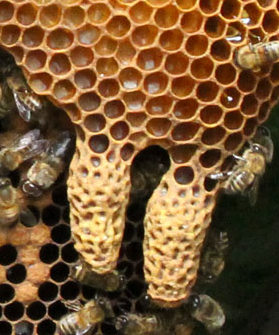
Swarming tends to reduce significantly when the days no longer lengthen so less attention is needed for swarm inspections. However, those colonies that were artificially swarmed or swarmed before they could be split must be checked for a laying queen. Large colonies can take up to 3 or 4 weeks before a new queen comes into lay after she emerges. So a colony may appear to be queenless but is just waiting for the new queen to start laying. A simple test is to add a frame of eggs from another colony and look at the frame a few days later. It is a good idea to place a pin in this frame in order to identify it when checking for queen cells. Move other frames away from the test frame in case any queen cells that may be present are not damaged when removing the test frame from the brood box. If no queen cells have been drawn a queen is present and should come into lay soon. If queen cells have been produced select one where a grub is visible in a good position on the comb and destroy all the others. Leave the colony for 3 to 4 weeks and then check for eggs.
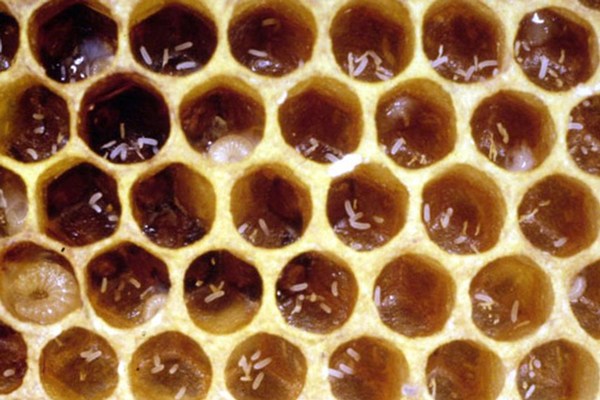
Recently I inspected a colony which had several frames of brood only to discover drones were present in worker cells. The sealed brood had domed cappings rather than a flat surface that is typical of worker brood. There were also several eggs per cell which is another indication of a laying worker. Note that new queens sometimes lay two eggs in some cells but practice eventually resolves this issue. Colonies with laying workers cannot be recovered so the only option was to take the brood box a little distance away and shake the bees off the comb and remove the hive from the apiary. Hopefully the worker that was laying would not be able to fly back to the original location and the remaining workers would find a home in neighbouring colonies. The brood frames were destroyed as they were potential varroa producers.
Another potential issue is frames of foundation in colonies that were artificially swarmed earlier in the season. When making up the artificial swarm brood box it is good practice to add frames of foundation in the box where the old queen is placed in. When making up an artificial swarm I like to give the old queen a frame of sealed brood (so the queen has young bees available to produce royal jelly), two or three drawn frames (so the queen can continue laying), and a frame of stores. So there could be 5 to 7 frames of foundation in the box with the old queen. Bees are sometimes reluctant to draw these frames especially the outside ones. For these colonies move a frame of foundation into the brood nest every 7 to 10 days. This forces bees to draw these frames as the nest has been split. My preference is to move one or two frames at a time into the nest to ensure these frames are drawn before the end of summer. During autumn feeding bees quite often ignore these blank frames meaning a colony could go into winter underweight because not all the frames are drawn.
The recent hot weather plus the June gap has significantly reduced the honey flow. But there are still a few weeks to go for bees to forage on blackberry etc. So make sure bees have enough super space in case of a late flow. If there is a good soaking in the coming days plants will start nectar production again and bees are opportunists – ready to take advantage of whatever is available to them.
Now is a good time to consider which varroa treatment to use in the coming weeks. My approach is to treat when no honey is on the hive so the intention is to remove honey from the hives by mid August in order that treatment can start. There is plenty of advice on Beebase on the different products available and attached is a pdf (varroa-pdf-2020) from Beebase showing the various products.
Last but not least – wasps. They can become a problem from July onwards and often target weak or diseased colonies and nucs especially. As we move through July it is a good idea to reduce the colony entrance to around an inch or so to make it easier for bees to defend. If wasps are in robbing mode on a colony it is difficult to stop. Definitely a case of prevention better than cure. Final thought, place wasp traps around the apiary to reduce wasp numbers. Traps can easily be made from jars with some small holes in the lid, spoon of jam and half fill with water. The wasps eventually drown but bees are not attracted to the mixture.
Regards
Wally