Author: content_editorial

October 2022 Apiary Notes from Wally Thrale

Two Queens

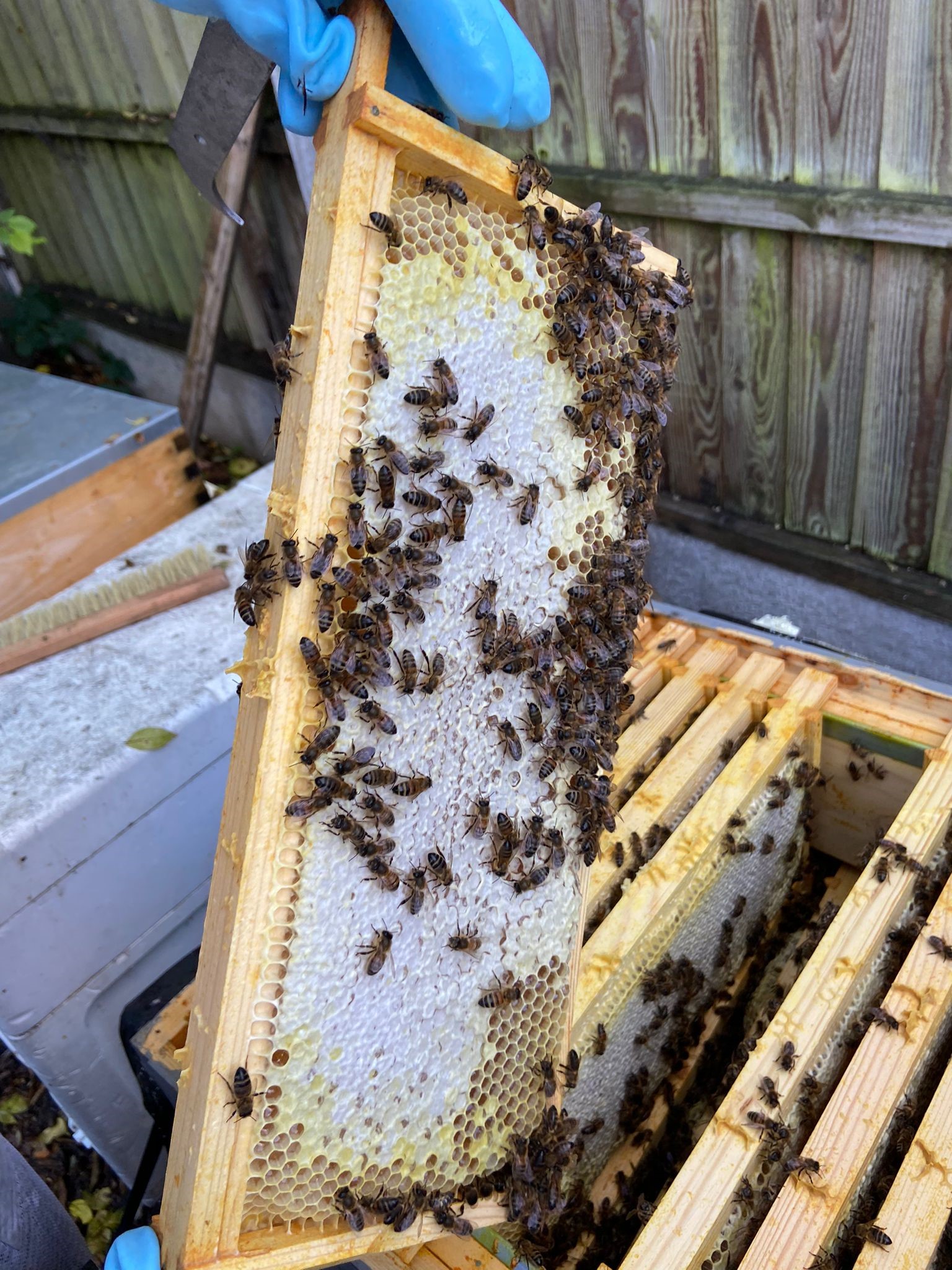
We are at the end of September and feeding should be well under way or finished by now. Last week the weather was summerlike and it was possible to inspect colonies to assess them and move empty frames around for the bees to fill. Bees seem to lose interest with the outside frames during feeding so can go into winter with ones or two empty frames. Placing full ones close to the wall and moving empty ones nearer to the nest encourages bees to fill these frames. By filling all available frames can mean the difference to a colony surviving the winter or dying out!

However, don’t be tempted to leave a feeder on a colony well into winter, especially if it already feels heavy enough. Doing this allows bees to store syrup in cells as the adult bees emerge thereby preventing the queen from laying in them. This means the size of the brood nest becomes smaller and smaller with potentially not enough winter bees for the colony to survive the winter. Or, if it does survive it is very weak in springtime and struggles to build up.

Knowing when a colony has sufficient stores is not easy to convey in these notes but comes from experience I’m afraid. Remove the roof (to give a more accurate idea of weight) and lift the brood box. I expect it to weigh around a sack of potatoes, i.e. 25kg. Unfortunately not everybody knows what a sack of potatoes feels like but that is the best I can do.

Once a colony has enough stores I return a super if I think the apiary will have a strong ivy flow. It appears that bees do not overwinter that well if they have a lot of ivy honey so I prefer the bees to place it in a super which is removed when ivy has finished flowering.

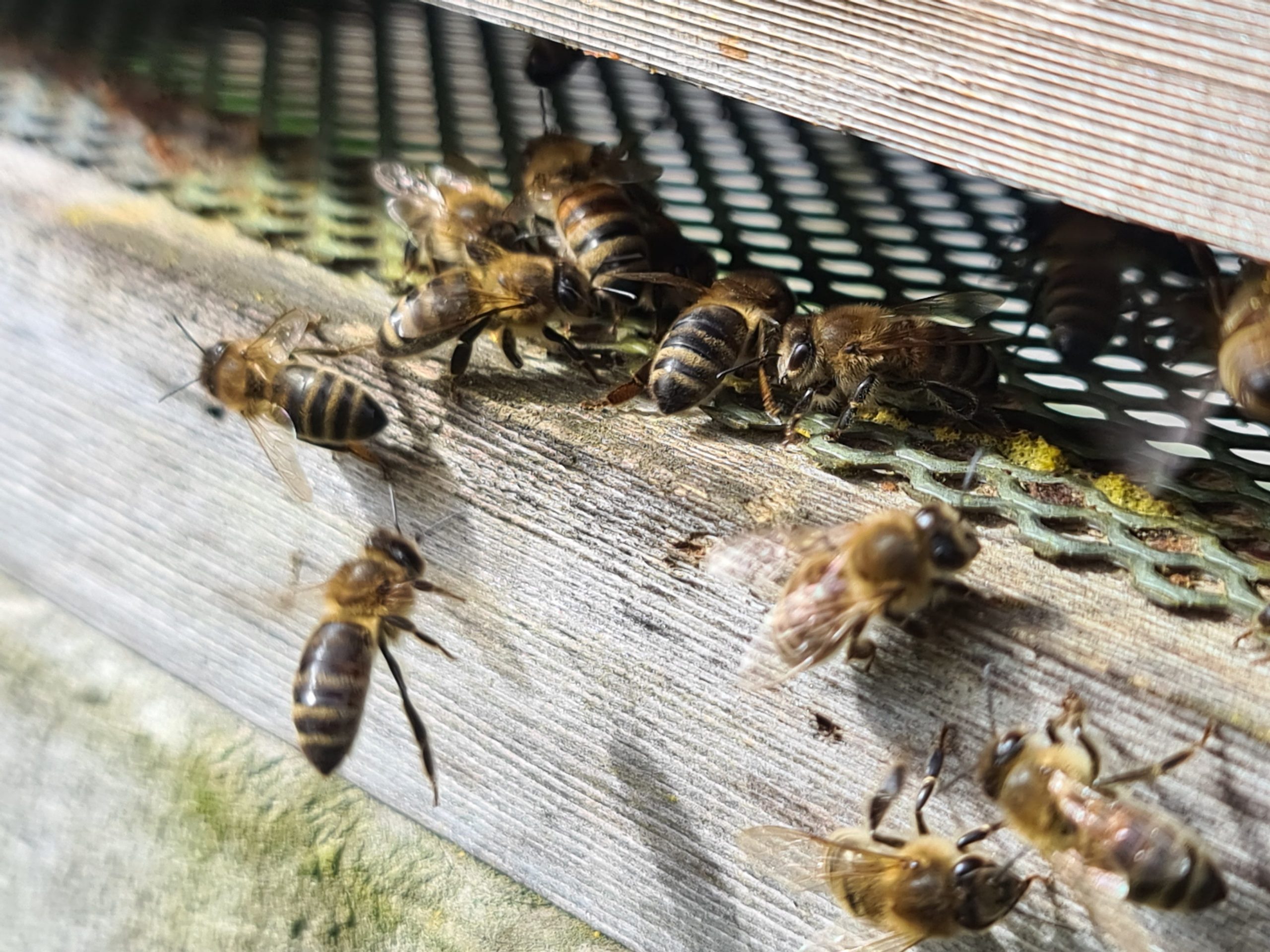
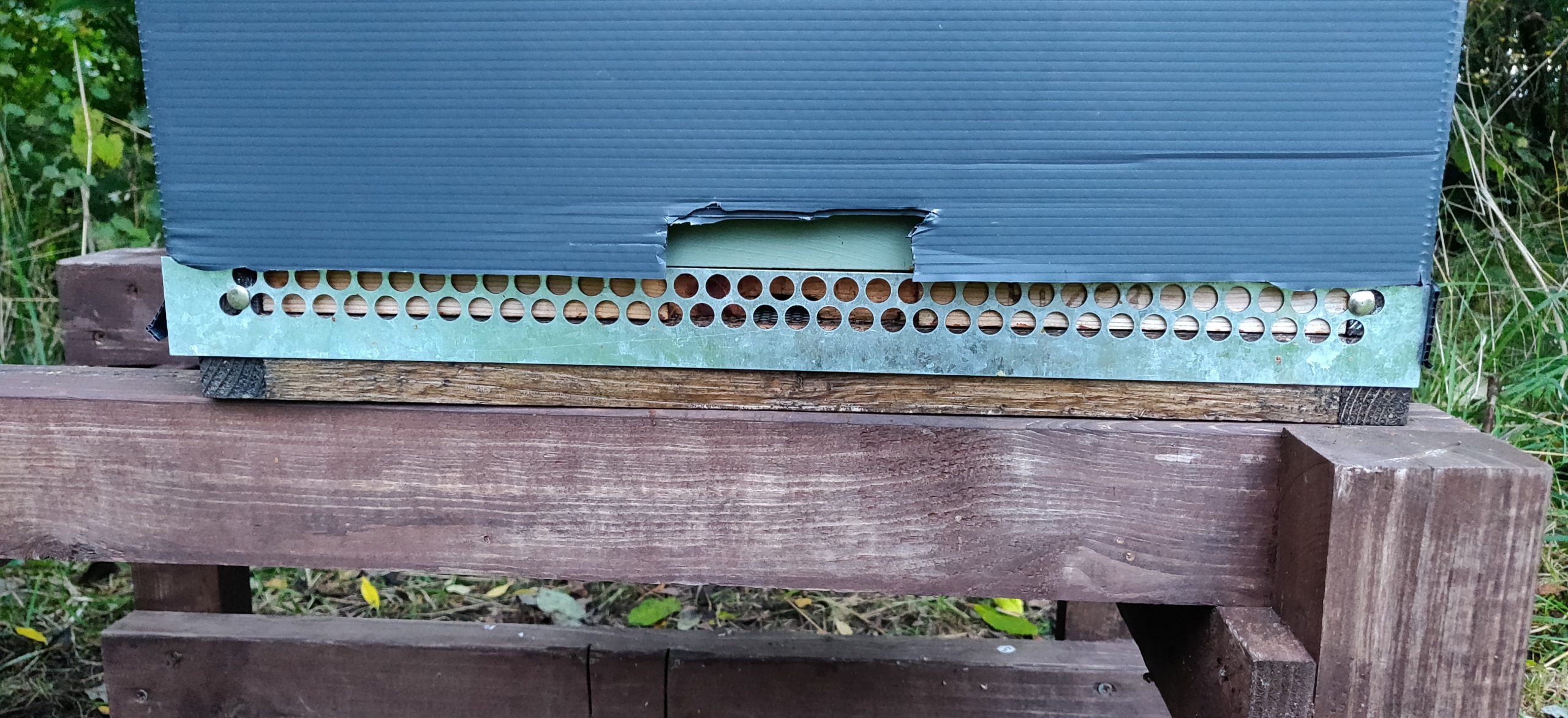
Looking through colonies last week I noted that most of them have a few frames of brood which will produce the winter bees. So bees will be bringing in pollen to feed the brood and a lot of it is ivy pollen. So don’t place mouseguards on hives for a while as they can knock off the pollen load from a forager. Generally it is better to place mouseguards after the first frost which hopefully will be several weeks away.

Whilst placing mouseguards it is a good idea to net hives at the same time to prevent access by woodpeckers. I also place a two inch thick piece of insulation under the roof and over the crown board to help retain heat. If solid floors are used then this should not be done as it may prevent adequate ventilation.

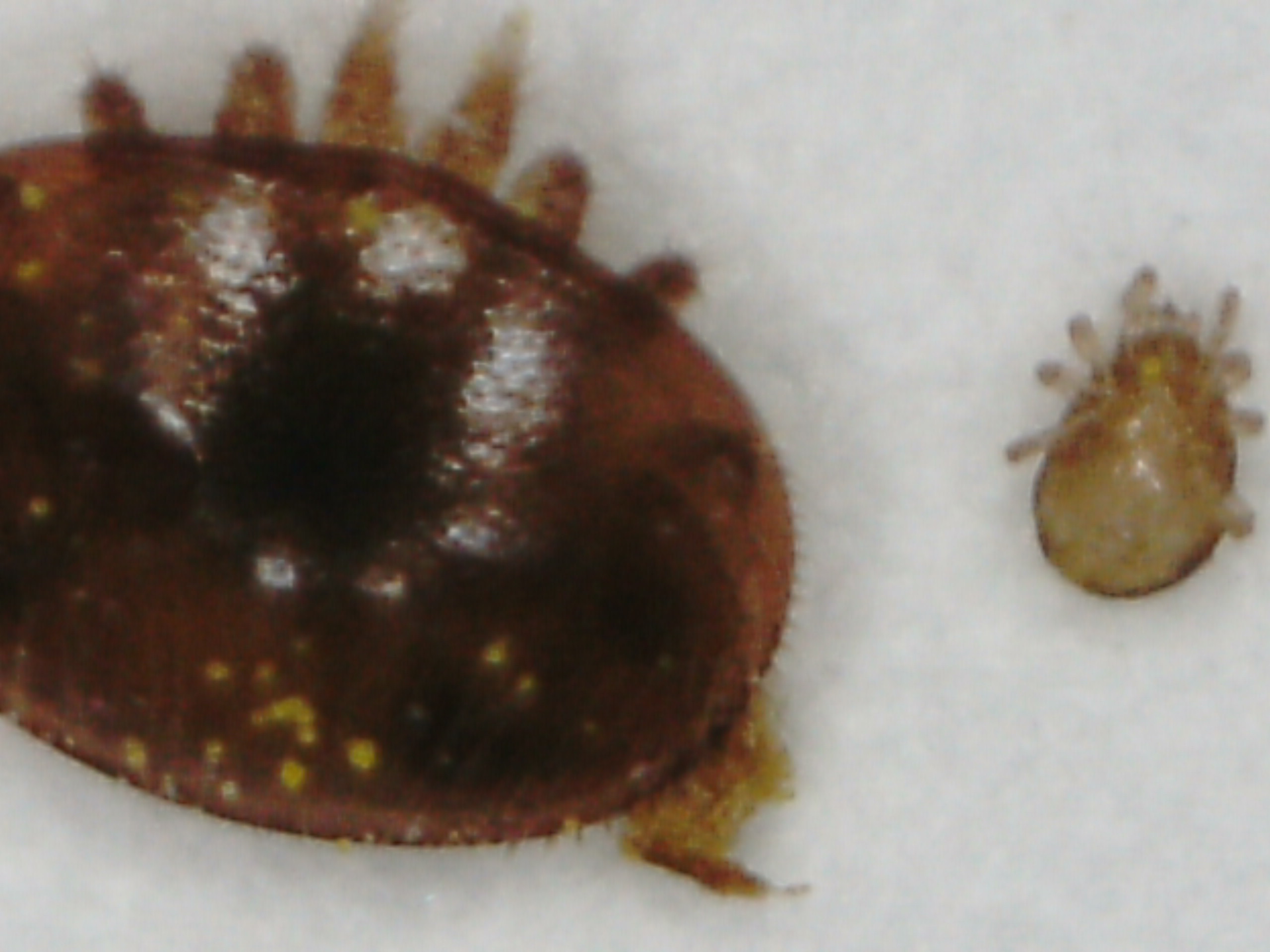
If you treated for varroa with strips, pads or trays remember to remove them when treatment time has elapsed. This can prevent mite resistance developing especially if Apivar, Apistan or Bayvarol were used.

Finally, if you are new to beekeeping and go to your bees later in autumn to place mouseguards on the hive, do make sure you are wearing protective clothing. A colony can appear very inactive lulling the beekeeper into thinking “I’ll just put this place with a couple of staples and job done”. As soon as the guard is placed against the hive wall bees often tumble out quite enraged at being disturbed on a cold autumn day. So do put on your beesuit – it could save you from a serious stinging incident!

August 2022 Apiary Notes from Wally Thrale

There will be a Zoom session on Tuesday evening, 23rd August at 7.30 pm, to chat over these notes or any other questions you may have. An invitation for the event will be sent out nearer the time and we meet for about an hour; depends on how many questions members put to us.

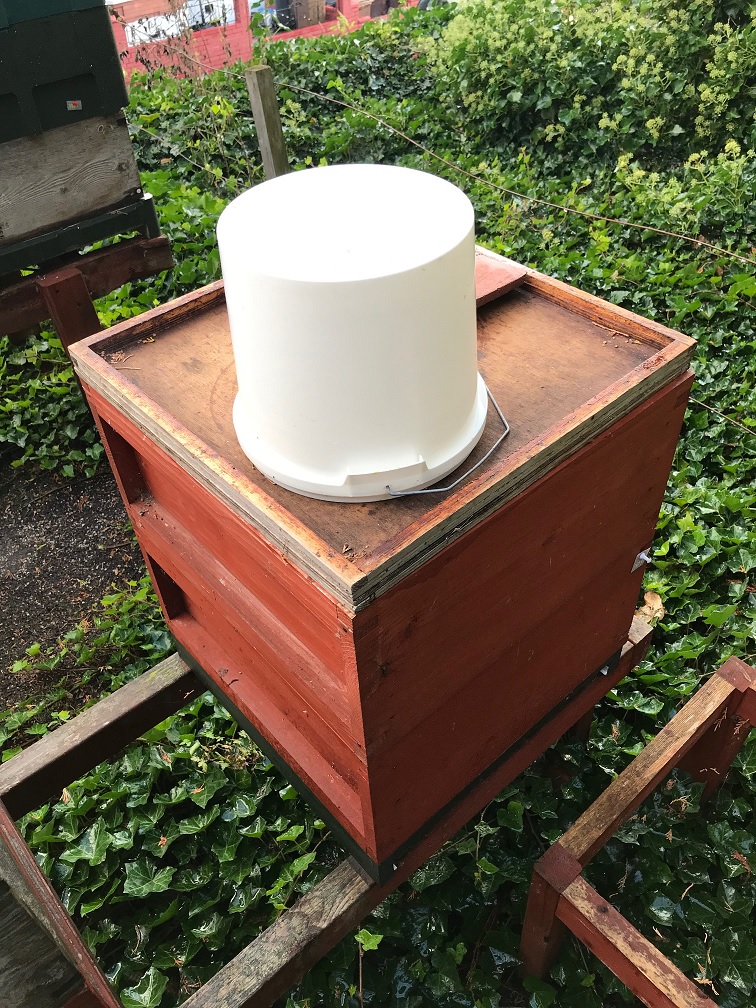
This hot weather is quite challenging for our colonies as they try to locate water to bring into the hive to help cool it down. Leaving containers with water near to hives helps bees find water as many natural sources have dried up. On the topic of heat some varroa treatments should not be used in high temperatures, e.g. MAQS pads which contains formic acid. Apiguard should be used in warm weather but I am not sure if 30c plus would have an adverse impact on colonies. Do check the instructions if you are using this varroa product.

At the start of September I shall start my winter feeding but carrying out a quick inspection of each colony to see if it looks viable. If there are several frames of brood, some of them containing slabs of sealed brood, I consider the colony in good shape. If it looks dubious the best thing to do is unite it elsewhere. If there are a couple of colonies that are like this I unite them leaving the queens in each box. Let the bees decide which queen they prefer. This only applies to colonies where there are no obvious signs of disease. It also may be necessary to unite colonies if increase has been made earlier in the year due to artificial swarming. Ideally the old queen should be killed and her brood united onto a hive with a current year’s queen. Young queens generally survive the winter better.

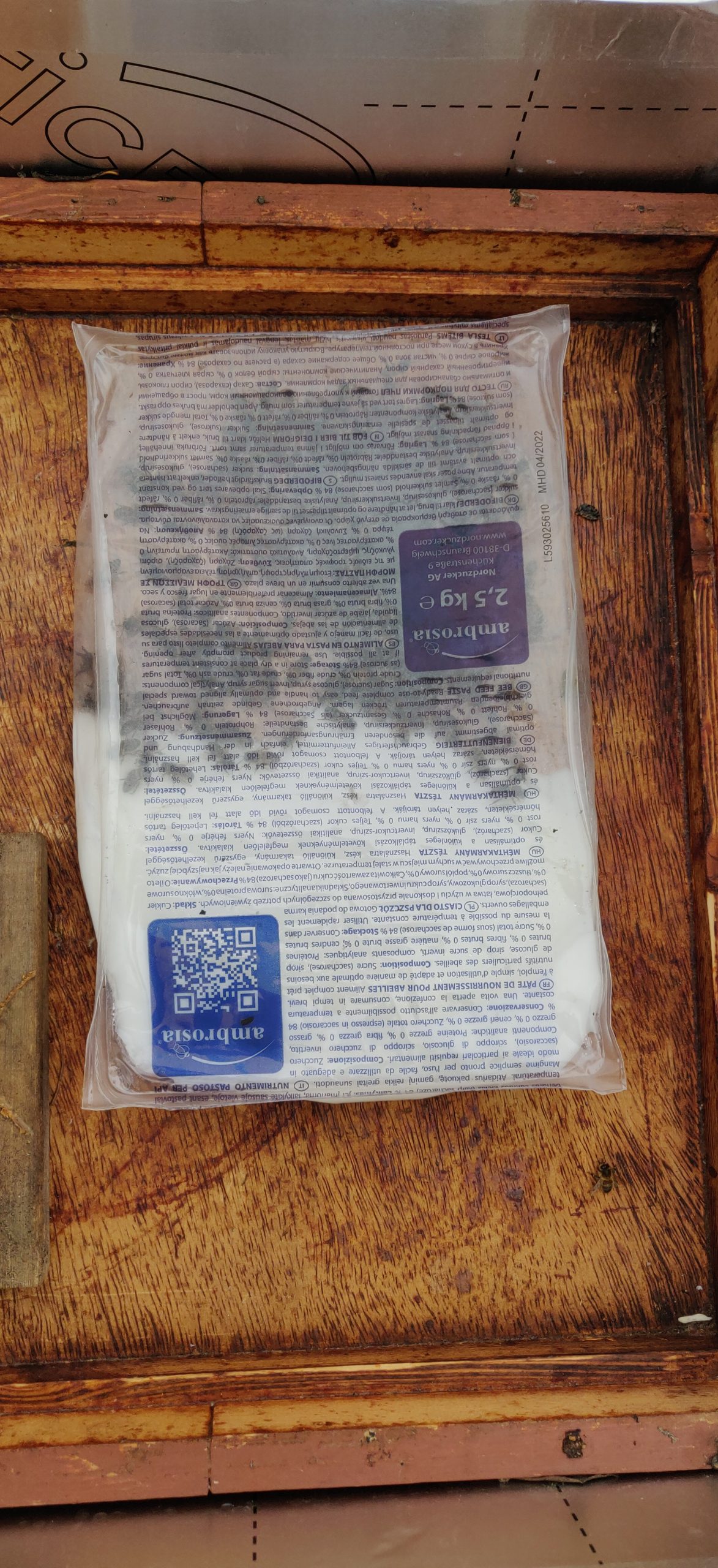
In a couple of weeks I shall start feeding and my preference these days is to use Ambrosia. This is an inverted syrup whereas bees need to invert sugar syrup which is more work for them. Ambrosia also keeps for at least a year so can be used in the spring if colonies require a top up before nectar is available. The aim is feed individual colonies as quickly as possible, providing around 20 to 22 kilos of stores for National hive on a single brood box.  If using brood and a half or a larger brood box then more stores can be provided. But remember to remove the queen excluder if using brood and a half. I’ve seen a queen die because the bees were in the super with the stores but they could not feed the queen in cold weather. If there are frames with just foundation after the artificial swarm process, bees are reluctant to draw comb late in the season if the frame(s) are by the wall. Move the frames with foundation to either side of the nest which encourages bees to draw them. Don’t place them in the centre of the brood nest as nights can become cold in autumn and brood could become chilled.

An important point to bear in mind is not to overfeed as this will restrict comb space for the queen to lay. The winter bees are raised during the autumn months and if brood frames are full of stores there will not be enough bees raised to maintain the colony over the winter.

The Association stocks Ambrosia so see the latest price list for location of stockists. For autumn feeding I always use syrup not fondant. Fondant is used when the weather is cold, mainly late winter or early spring, as bees won’t process syrup at this time but are happy to tuck into a block of fondant.

My aim is to finish feeding around the end of September as the ivy starts flowering later in the month. Bees don’t seem to overwinter too well if they have a lot of ivy honey in the brood frames. So feeding syrup before the ivy flowers prevents bees storing this honey in the brood box.  After feeding I leave one super on the hive for bees to store any ivy they manage to locate which is removed before winter.

July Apiary Notes from Wally Thrale

We are approaching mid-July which is the time when wasps tend to make their appearance around our colonies. Being prepared is better than trying to stop wasps once they have targeted a hive. It is a good idea to reduce entrances down to around an inch or so, smaller than this for nucs. Once wasps have found a way into a hive it is very difficult to stop them. They can easily take out a weak colony or nuc in a short time. They then move on to the next target. Do get the foam ready and apply soon.

We will need to consider taking away supers for extraction when the honey flow finishes although I hear from some members that supers are being filled at the moment. The end of a honey flow becomes quite obvious by looking at the entrance as there will be little flying activity. In fact we should always look at the hive entrance as it gives an indication of the state of a colony.

At the end of the season (typically end of July to early August) there are often super frames that are not capped over as the bees are waiting or hoping for another nectar flow. By having local knowledge of the local flora we will know if another flow is likely or not. It is best to leave supers on the hive for a few days when a flow has finished to allow time for the bees to ripen the latest batch.

Uncapped frames can be extracted but do the ‘shake’ test first. Hold the frame firmly with one side facing downwards and give a good shake. If no honey falls out it is safe to extract the frame. If honey does fall out put these frames back into a separate super and return to the bees for a few days, where they will finish ripening the honey.

To remind you, the Association has several extractors around the county which can be borrowed at no cost (see p64 of the Yearbook). Obviously, they may be in demand around early August so be aware that you may have to wait a little while.

Many beekeepers treat for varroa in August which means no honey should be present. Some members are reducing varroa treatment to once a year or have apiaries that are not treated at all. Personally, I shall continue to treat for varroa until I see strong evidence to show that this regime is sustainable. Remember the adage that ‘dead bees don’t produce much honey!’ At the end of these notes are descriptions of various types of varroa treatment available. This is taken from 2020 notes but I thought it might be helpful to give an overview here of most available treatments.

Next Tuesday (19th July) we will run a Zoom session to talk over any of these points or anything else you may wish to ask. The invitation will be sent out nearer the time.

Finally, it is not too late to make nucs to overwinter and is something all beekeepers should try to do in case of a bad winter. An easy way to produce queen cells is by the Miller method which is described below.

A colony can be deliberately made queenless by moving the queen and a couple of frames of brood with bees into a nuc or killing the queen in a colony which does not have favourable characteristics. Move the nuc to another apiary to prevent foragers returning home. Now go to another colony which has desirable traits and place a frame with foundation in the middle of the nest. After a few days (around 4 to 6) the bees normally draw the frame sufficiently to allow the queen to lay. This does require a flow of honey in order for the comb to be built. Check the frame after 5 days and, if eggs are present, shake the bees off and cut out ‘V’ shaped angles at the bottom of the frame so there is a gap between the comb and the bottom bar.

Place the frame of eggs in the queenless colony but knocking down all the queen cells first that the bees have built since becoming queenless. Also place a frame containing lots of pollen next to the eggs so the nurse bees have easy access to protein. After 7 days the bees will produce queen cells ready to harvest, normally along the edges of the ‘V’ cut-out. The number will depend on the time year, how strong the colony is and the strain of bees.

Nucs can now be made up to receive a queen cell which can be cut out of the frame using a sharp DIY blade. Cut well away from the queen cell going deep into worker cells so that the queen cell is not damaged. Make the nuc up a couple of hours before adding the queen cell so the bees know they are queenless. Then place a cut out queen cell between the top bars of frames in the centre of the nuc and move the frames together slightly to hold the queen cell in place. Leave the nuc for two to three weeks after which time eggs should be present. If available, add a frame of sealed brood from another colony to boost its numbers. If a polynuc is used the bees produced this time of year will tick over until next spring when they can be transferred to a full colony.

Regards
Wally


Varroa treatments.
When treating my bees for varroa is never to do it when honey is present. This way I know I cannot contaminate the honey regardless of what the instructions say. For some products the honey must be removed and some say it is ok to treat with it present. I prefer to take supers away and then I know I am completely safe.

Most varroa treatments are harsh and make life for bees unpleasant. The aim of treatments is to be strong enough to kill mites but not the bees. But without treatment most colonies will die out. This statement can open a can of worms so I’ll leave it at that.

MAQS – formic acid is the active substance and you can tell as soon as the lid is removed from the container even when the pads are still in their wrapping. The smell is very strong and I wouldn’t want to be exposed to the substance for any period of time. Many people find it very effective and the treatment is over in 7 days. There are reports of it killing queens if there is not enough ventilation. Recently I heard of someone who lost a lot of bees as well as the queen when treating with MAQS – so be very careful and follow the instructions closely.

Apiguard – contains thymol in two trays and takes four weeks to treat (two weeks per tray). This product is temperature sensitive so must be used in August whilst we have good daytime warmth. My view is that it can have variable effectiveness and can also put the queen off lay at a time when I feel she should be producing the winter bees. Read the instructions carefully as mesh floors must be blanked off and ventilation restricted.

Apivar – the active ingredient is Amitraz. The treatment time is six to ten weeks using two strips per hive and is very effective. However, if the product is used each year mites can develop resistance and then it will become unusable. This happened years ago with Apistan when the mites developed resistance. So varroa treatments should be changed each year to prevent mites developing resistance.

Apistan / Bayvarol  – these are similar products. Apistan contains fluvalinate and Bayvarol flumethrin. The treatment is the same as Apivar – two strips per hive for a minimum of six weeks. All treatments using strips should be removed before winter as they become weaker over time. This means that mites then can then tolerate the weaker dosage and develop resistance in this way.

Oxalic Acid – Treatment can be either by trickling or vaporisation; both are effective although vaporisation is reported to be more effective. Vaporisation requires a car battery and a hot plate plus a breathing mask as oxalic fumes are dangerous to humans. For trickling there are 3 approved products (Api-Bioxal, Oxybee and Oxuvar). I have only used the trickle method and found it to be very effective.

My current regime is a mixture of oxalic acid trickling in winter and spraying Varroamed in March / April and August. This product does not kill mites but causes them to fall off the bee as they do not like the taste. So, it is essential to use open mesh floors without the insert so the mites fall on the ground. The aim of my regime is to prevent mite levels becoming too high where they can cause damage to the brood – hence the different treatments during the year.  The product is sprayed onto the top of brood bars. It has little impact on the bees (it does contain oxalic acid but much weaker than the winter treatment). As mentioned, this is applied twice during the active season – once before supers are added and again when they are removed. Oxalic acid is then trickled between seams of bees just before xmas. Oxalic acid in winter can be used only once as it affects the gut of bees. As I mentioned earlier most treatments are harsh on bees but this regime seems to me to be the least harmful.

You may want to place the plastic insert under the floor (if the product you are using does not require the floor to be ventilated) to monitor mite drop. There can be wide variations between colonies in their mite knock down which often comes as a surprise. Personally, I do not use inserts as my floors are homemade and do not take an insert. However, I regularly remove drone pupae during the main part of the season and look for mites on the developing drones. This normally gives a good indication if there is a mite problem or not. Another thing to look for are bees with deformed wings (DWV) which can indicate that there is a mite issue if many bees are affected.

There are other products on the market but I have not tried them so I have not mentioned them in these Notes. My aim here is to give an appreciation of the popular products and issues there may be in their use. But do treat with something otherwise your bees may not survive till next spring.
June 2022 Apiary Notes from Wally Thrale

Each spring we have a weather issue to contend with. Two years ago we had record amounts of spring sunshine, last year there were air frosts on most nights during April. This year was one of the driest April / Map periods I can remember. The dry weather held back crops and reduced nectar flow for rural crops and, I suspect town and village gardens were similarly affected.

But now we are at the height of the swarm season so checking for colonies making queen cells is still important. For colonies that were artificially swarmed with frames of foundation do check the bees are drawing comb – sometimes it is necessary to rearrange these frames so that all the foundation is drawn by the end of summer. Last year I wrote quite detailed notes on the artificial swarm process when introducing frames of foundation. Rather than repeat it here please follow the link as I hope I provides enough detail on how to manage the whole process:

https://bedsbka.org.uk/article/june-2021-apiary-notes-from-wally-thrale/


Many of us have taken off our spring crop and I have found that my crop is down on normal years. It is tempting to extract all supers on a hive but remember to leave some stores for the colony. Queens in National boxes are often prolific and can almost fill all the frames with brood leaving little room for stores. So a super containing some honey should be left on the hive.

If you have spare brood frames containing stores one or two can be added to the brood box to provide the bees with food. In fact it may be necessary to feed during June as some sites may have very little forage. But ensure that the syrup is not stored in super frames as it will contaminate the honey. We don’t want local honeys sold containing sugar as that will be a PR disaster.

Lastly, ensure enough supers are present on the hive to accommodate the bees. Supers aren’t just used for honey storage – strong colonies can become congested through lack of super space. Congestion is one of the swarming triggers so, when the top super is full or almost full, add another super. This applies to the peak of the season; in late summer the colony is reducing in size so this no longer applies.

Following the previous Zoom Improver session we received a request asking if we could talk about differing brood boxes, e.g National, Commercial, brood and half, double brood etc. So I mention this with some trepidation as many beekeepers have strong views on this topic. However, I think we should cover this as there are pros and cons for each of the configurations. What works for one person doesn’t for another but to hear the arguments helps us decide on what to try in future.

So do come along to the Zoom session on Tuesday 14th June at 7.30pm. An invitation will be sent to members beforehand so look forward to seeing you there.

May 2022 Apiary Notes from Wally Thrale

Some colonies have built up strongly and need plenty of super space if only to accommodate the bees! In spring I leave a super over the crown board as a precaution. It is amazing how quickly a colony can fill a super in ideal conditions so do check bees have enough super space.

It is now early May and some colonies have swarmed already. So we all need to check our bees regularly for queen cells.

There are 3 elements to consider when dealing with swarming: there is the queen, the flying bees and the brood. If one of these elements is removed it will stop a colony from swarming (or delay them).

The following is what we do with a conventional artificial swarm. The box containing the brood is moved to another spot in the apiary and the queen located. A new box containing drawn frames and some with foundation is placed on the original site and the queen returned. In this scenario the brood is removed and mimics a natural swarm. My preference is to place a frame of mainly sealed brood in with the queen so there are young bees coming through to look after and feed her.

So in the above by removing the brood we have prevented swarming.

If the queen cannot be found then we can carry out the same box arrangement as above but locate a frame with mainly eggs on it. Shake the bees off to make sure the queen is not on the frame. The bees can remain on the frame If you are certain the queen is not there. Place this frame in the box with foundation and drawn frames. Place a queen excluder over box and return a super (this provides stores as the brood box is mainly empty). If there are two or more supers I share them out between the two brood boxes. The bees will produce queen cells on the frame containing eggs – return to the hive a week or so later and leave one good looking queen cell. A new queen will emerge and eventually start laying in this box.

In this scenario we have removed the flying bees but the queen is still with the brood. The box with the queen will soon become active again so ensure it has super space if there is a flow.

The remaining option is to remove the queen and leave the brood and flying bees. In order to carry out this procedure it is preferable to use a nuc. Place the frame with the queen in the nuc and, if possible, another frame of mainly sealed brood. Give the nuc a couple of frames of stores and fill up the remaining space with either empty drawn comb or frames with foundation. As there is a laying queen the nuc can soon become congested so this needs to be monitored. Replace a frame of sealed brood if the nuc looks as if will become too crowded. Ideally move the nuc to another apiary as the flying bees will return to the original location.

Just a note when leaving a brood box containing just brood with queen cells as we need to knock down queen cells to prevent casts etc. It is good practice to knock down sealed queen cells as long as open ones are present containing a grub. Some people leave a single queen cell and others leave two as insurance. However, bees may swarm in this situation as the first queen to emerge will depart with the swarm leaving behind the other queen to take over the colony. How bees know if there is one or more queen cells is not something I can answer – that’s another bee mystery.

So there are many ways of dealing with swarming and other beekeepers will have variations on any of the above. Most importantly we are at the start of the swarming season now and good weather is forecast for a while. Bees no doubt will decide it is an ideal time to swarm so be prepared!

We will chat about swarming on Tuesday evening (May 10th) from 7.30pm on Zoom. An invitation will be sent out nearer the time and the session will be recorded.

April 2022 Apiary Notes from Wally Thrale

For the first inspection of the season my main priority is to find the queen, clip and mark her. When bees are producing queen cells it is normally easy to find a marked queen. Carrying out an artificial swarm does take time and often several colonies are at the same stage, each taking a period of time to deal with. As marked queens are much easier to find it saves time during this process. Having a clipped queen does not stop swarming but it ‘buys’ me a few days if the weather prevents regular inspections. Swarms normally settle nearby to their home hive and check that the queen is with them. If she isn’t the bees return home sometimes finding the queen. It is not unusual to find a swarm under the floor of the parent colony and I check the floor first before opening a hive during swarming time.

The weather forecast sounds promising for the coming week or so. All colonies now have a super; if the brood box is full of bees then a super goes below the crown board and one above. If the brood box is more than half full of bees then the super goes above the crown board. If the colony is weak no super is added. Nights can be cold during April and I don’t want too large a volume for the bees to keep warm at night. Providing a super over the crown board allows bees to ‘expand’ during the day but during the night they return to the brood to maintain the temperature.

Bees tend not to swarm in April but the swarming process can be triggered if bees consider themselves cramped. So it is important to give bees more space so they don’t feel overcrowded. If warmer weather is on the way we could have a honey flow and bees will need the room for the incoming nectar.

Finally, we are running a Zoom Improver session this Tuesday evening at 7.30. John MacDougal has kindly sent emails advertising this event and Richard Smith will be present to answer questions as well. If you have any points about the apiary notes or questions in general, do come along on Tuesday and we will try to answer them.

Regards

Wally

March 2022 Apiary Notes from Wally Thrale

he main purpose of the notes this month is to promote the Training Day we are running at Houghton Conquest village hall on Saturday 19th March, starting at 10.30am. The day will finish at 3pm with a Q&A session after the last talk where members can pick the brains of the assembled panel.

Note – please bring your own lunch and refreshments to allow speakers etc to concentrate on the talks and running the day.

If you wish to attend please do sign up via Webcollect so that we have a rough idea of numbers. The hall is a reasonable size but we mustn’t exceed the fire safety limit. Or you can drop me an email at w.thrale@ntlworld.com to let me know you want to attend.

We have invited Peter Folge, our seasonal bee inspector and a very experienced beekeeper, to talk about the do’s and don’ts of beekeeping. As Peter visits so many beekeepers during the season I’m sure he has seen a wide variety of beekeeping practices which will be interesting to hear about. Hopefully we can then prevent some pitfalls in our beekeeping.

Topics for other speakers are:

Colin Hall on using nucs when carrying out an artificial swarm.

Gill Brewer talking on conventional artificial swarm control – just to remind us how to go about this.

Mike Niemann on raising several nucs from a colony that has good characteristics using its queen cells.

John Macdougall on using mating nuclei and adjusting a refractometer.

Richard Smith & Jenny Tysom demonstrating a wax steamer (the Association has 3 steamers around the county which can be loaned to members).

Richard Smith on wasp precautions. We so often hear of beekeepers losing colonies to wasps in the summer which can be prevented.

Wally Thrale showing a super designed for round sections and how to get the bees to work the super.

Over lunch I hope we can show how to make wax wraps and candle making.

NOTES
So for March do check colonies have enough stores as some boxes are becoming light, especially National hives. If a colony feels light then feed it some fondant or syrup. As the days are slowly becoming milder bees will accept syrup from now on. Better to be safe than sorry as there are several weeks before we can expect a honey flow.

Also remember to remove the mouse guards during this month. Bees are already bringing in pollen when the weather allows. Colonies are starting to build up now and they need lots of pollen. Mouse guards can knock pollen loads off incoming bees so best to remove them soon.

February 2022 Apiary Notes from Wally Thrale

Now we are into February it is important to check the weight of colonies. Over the past week I have taken the roof off each of my colonies and lifted the brood box. This gives me a very good indication of the weight of each box. Most colonies felt quite heavy still but some I decided to feed with fondant. The Association has recently bought boxes of fondant which contain 5 packs each weighing 2.5kgs. (Supermarket fondant may contain additives so I avoid using them as they may be harmful to bees.) These blocks are ideal and easy to cut in half. Leaving the plastic around the fondant prevents it from drying out but bees can access it from where the block is cut. My preference is to place this slab over the bee cluster with a shallow eke to provide space for the block. The crown board then sits on the eke thereby keeping the volume the bees need to warm to a minimum. However, some colonies were all over the top bars so the block of fondant was placed over the crown board (to prevent squashing) and as close to the bees as possible by a feed hole. The shallow eke was then placed on the crown board.

Most of the colonies that needed feeding were Nationals although a couple of Commercials were fed as they were not very heavy. The important point here is that the next couple of months are the danger time for colonies as they start to consume more stores each day. When daytime temperatures are consistently above 10c I shall feed light colonies syrup using a small tray feeder as these are easy to apply and keep the colony going long enough until there is forage available.

One other item to check is the hive entrance. Sometimes they become blocked with dead bees which need clearing to allow forages to leave the hive. Small point but important.

This week I completed maintenance of my supers by scraping top and bottom bars. All spare equipment will be painted with a wood treatment well before they are needed so they will have had enough time to air. Once the season starts it is often too late to carry out these jobs so I am trying  to have spare kit ready and waiting for transport to the apiaries.

The season is not too far away and, the trading day at Flitwick at the end of the month can be considered the starting point for the season.

Here’s hoping for better weather than last year.

Wally

October 2021 Apiary Notes from Wally Thrale

We are at the end of September and feeding should be well under way or finished by now. Last week the weather was summerlike and it was possible to inspect colonies to assess them and move empty frames around for the bees to fill. Bees seem to lose interest with the outside frames during feeding so can go into winter with ones or two empty frames. Placing full ones close to the wall and moving empty ones nearer to the nest encourages bees to fill these frames. By filling all available frames can mean the difference to a colony surviving the winter or dying out!

However, don’t be tempted to leave a feeder on a colony well into winter, especially if it already feels heavy enough. Doing this allows bees to store syrup in cells as the adult bees emerge thereby preventing the queen from laying in them. This means the size of the brood nest becomes smaller and smaller with potentially not enough winter bees for the colony to survive the winter. Or, if it does survive it is very weak in springtime and struggles to build up.

Knowing when a colony has sufficient stores is not easy to convey in these notes but comes from experience I’m afraid. Remove the roof (to give a more accurate idea of weight) and lift the brood box. I expect it to weigh around a sack of potatoes, i.e. 25kg. Unfortunately not everybody knows what a sack of potatoes feels like but that is the best I can do.

Once a colony has enough stores I return a super if I think the apiary will have a strong ivy flow. It appears that bees do not overwinter that well if they have a lot of ivy honey so I prefer the bees to place it in a super which is removed when ivy has finished flowering.

As an aside, one of the reasons I prefer using commercial brood boxes is that I can feed a colony till it feels heavy but know that there is still space for the queen to lay. My commercial boxes seem to overwinter better the National boxes I run.

Looking through colonies last week I noted that most of them have a few frames of brood which will produce the winter bees. So bees will be bringing in pollen to feed the brood and a lot of it is ivy pollen. So don’t place mouseguards on hives for a while as they can knock off the pollen load from a forager. Generally it is better to place mouseguards after the first frost which hopefully will be several weeks away but, as we have seen with our weather this year, we just don’t know what we will have. As Mark Twain said: “climate is what we expect; weather is what we get”.

If you treated for varroa with strips, pads or trays remember to remove them when treatment time has elapsed. This can prevent mite resistance developing especially if Apivar, Apistan or Bayvarol were used.

Finally, if you are new to beekeeping and go to your bees later in autumn to place mouseguards on the hive, do make sure you are wearing protective clothing. A colony can appear very inactive lulling the beekeeper into thinking “I’ll just put this place with a couple of staples and job done”. As soon as the guard is placed against the hive wall bees often tumble out quite enraged at being disturbed on a cold autumn day. So do put on your beesuit – it could save you from a serious stinging incident!

Regards
Wally

August 2021 Apiary Notes from Wally Thrale

Apologies for the lateness of these notes.  Last month I mentioned that varroa treatment should be carried out in August, especially if temperature sensitive. The link below shows an overview of several varroa treatments I have used with some pros and  cons for each one. Rather than reproduce it here you can view the notes from last year by following the link:

https://bedsbka.org.uk/article/august-2020-apiary-notes/

The beekeeping season has finished now and the weather has been the poorest one I can remember in over 30 years that I have kept bees. The best description for the season perhaps is ‘challenging’ with poor honey yield, problems with queen mating and generally difficult conditions for beekeeping. Yesterday I wanted to remove honey but it was too windy and cold to do so – and this is the middle of August!

Enough of grumbling and onto to what needs doing. As already mentioned I am trying to remove any honey that is available in supers for me to extract but only if the bees have enough stores in their brood frames. If not I will remove the honey just before commencing feeding otherwise bees will starve.

Wasps area problem in some parts of the county so entrances should be reduced to a small gap so bees can defend themselves easier. Putting out wasp traps helps to reduce the wasp population although removing dead wasps daily can become tedious.

Once honey is extracted I return the supers over the crown boards of a few colonies for the bees to clean out. Supers shouldn’t be stored ‘wet’ as they will go mouldy over winter. If stored wet they are an attraction for local bees and wasps which results in a lot of dead insects, especially if left open in the apiary. Super comb is a valuable commodity and should be looked after. There is an article in the Good Practice section of the website explaining how to store supers. Follow the link below:

https://bedsbka.org.uk/membership/good-practice/storing-supers/

Before winter feeding I carry out a quick inspection of each colony to see if it looks viable. If there are several frames of brood, some of them containing slabs of sealed brood, I consider the colony in good shape. If it looks dubious the best thing to do is unite it elsewhere. If there are a couple of colonies that are like this I unite them leaving the queens in each box. Let the bees decide which queen they prefer. This only applies to colonies where there are no obvious signs of disease.

In a couple of weeks I shall start feeding and my preference these days is to use Ambrosia. Mixing sugar syrup for many colonies has little appeal for me.  Ambrosia is an inverted syrup whereas sugar syrup the bees need to invert it which is more work for them. Ambrosia also keeps for at least a year so can be used in the spring if colonies require a top up before nectar is available. The Association stocks Ambrosia so see the latest price list for location of stockists. For autumn feeding I always use syrup not fondant. Fondant is used when the weather is cold, mainly late winter or early spring, as bees won’t process syrup at this time but are happy to tuck into a block of fondant.

My aim is to finish feeding around the end of September as the ivy starts flowering later in the month. Bees don’t seem to overwinter too well if they have a lot of ivy honey in the brood frames. So feeding syrup before the ivy flowers prevents bees storing this honey in the brood box.  After feeding I leave one super on the hive for bees to store any ivy they manage to locate. This can be removed when it has finished flowering and some people find it a tasty honey. It’s a little like Marmite – people love it or hate it.

Regards
Wally